Keyboard Shortcuts?f

×
  • Next step
  • Previous step
  • Skip this slide
  • Previous slide
  • mShow slide thumbnails
  • tShow transcript (+SHIFT = all transcript)
  • nShow notes (+SHIFT = all notes)

Please be cautious in using the transcripts.

They were created mechanically and have mostly not been checked or revised.

Here is how they were created:

  1. live lecture recorded;
  2. machine transcription of live recording;
  3. ask LLM to clean up transcript, and link to individual slides.

This is an error-prone process.

Click here and press the right key for the next slide.

(This may not work on mobile or ipad. You can try using chrome or firefox, but even that may fail. Sorry.)

also ...

Press the left key to go backwards (or swipe right)

Press n to toggle whether notes are shown (or add '?notes' to the url before the #)

Press m or double tap to slide thumbnails (menu)

Press ? at any time to show the keyboard shortcuts


Moral Reframing and Process Dissociation

insert-transcript#be62cb1d-e85b-4f64-abac-0dd7f7f26384-here

We encountered puzzles

which we are now in a position to resolve.

ok, now I come to the puzzles
insert-transcript#4f736c3e-b4b5-4f79-8607-c8c7583de5b4-here

puzzle

If the evidence for cultural variation in moral psychology is at best weak,
and if the theoretical argument for moral reframing is flawed,
why does moral reframing seem to work?

Here’s the puzzle. I’m going to do a tiny flash of revision in case you’ve forgotten some of the details ...
insert-transcript#91ee3d28-9e43-4527-b2b1-f496a3ed42b4-here

[recall]

cultural variation

Liberals and conservatives differ in moral psychology. Liberals are more concerned with harm and fairness. Conservatives are more concerned with loyalty, authority, and purity.

+ climate change literature stressing harm, fairness

explains political conflict

which moral reframing can overcome.

insert-transcript#5c700bb9-8915-4bb2-bf8c-c1f1858baebf-here

Why does moral reframing work?

hypothesis 1

match

There is cultural variation in moral foundations.

Reframing engages the morals of the target culture.

Moral engagement influences action.

Two kinds of objection to this claim.
Lack of scalar invariance.
And another objection, a theoretical one, which supposes that the evidence is good ...
insert-transcript#3712cbd9-f050-4394-816e-bf113cf2ad64-here

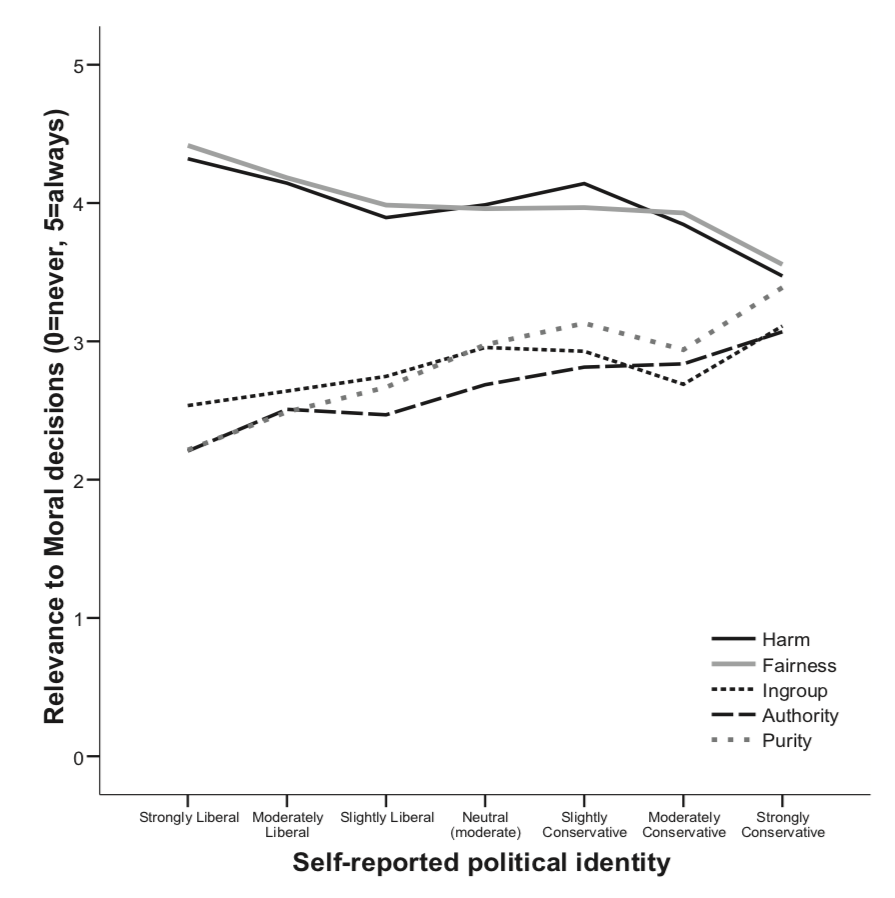
Graham et al, 2009 figure 1

The Joan-Lars-Joseph objection (revised)

The evidence on cultural variation says conservatives and liberals differ little, if at all, on harm and fairness.

The evidence does not say that conservatives put more weight on harm than on purity or authority.

The evidence on cultural variation, particularly the meta-analysis by Kivikangas, Fernández-Castilla, Järvelä, Ravaja, & Lönnqvist (2021), suggests that while conservatives score higher on binding foundations (loyalty, authority, purity) with medium effect sizes, the differences on individualizing foundations (care/harm, fairness/reciprocity) are generally *small* (pooled effect sizes around -0.1 to -0.25).
This suggests broad agreement across the political divide on the importance of harm and fairness, even if small differences exist.
The objection is: If conservatives and liberals regard harm and fairness as roughly equally morally relevant (or only slightly differently), this doesn't explain why framing climate issues in terms of harm should make it appeal more to liberals than to conservatives.
We *can* see why framing climate change in terms of purity would make the issue seem more moral to conservatives than to liberals.
But we *cannot* see why conservatives would framing climate change in terms of purity rather than in terms of harm would make the issue seem more moral to conservatives.
insert-transcript#68f8c072-20e6-4c92-b524-f6603988b839-here

puzzle

If the evidence for cultural variation in moral psychology is at best weak,
and if the theoretical argument for moral reframing is flawed,
why does moral reframing seem to work?

insert-transcript#02750ffa-f0a2-4d43-ab16-62e4db7fd861-here

Why does moral reframing work?

hypothesis 1

match

There is cultural variation in moral foundations.

Reframing engages the morals of the target culture.

Moral engagement influences action.

hypothesis 2

source

Targets identify the source as an in-group

and so construe the message favourably

increasing willingness to act.

Now the problem is, as we saw, that the evidence on moral reframing broadly favours the match hypothesis.
Of course both Match and Source are likely factors. The issue is whether we can explain the effectiveness of moral reframing without relying on the Match Hypothesis at all.

but: good evidence for match!

The puzzle is that we think the Match Hypothesis explains some of the effects of moral reframing, but we do not understand how this is possibe.
insert-transcript#dbe80166-577b-4026-93ac-a71fc18a461f-here

The Match Hypothesis is well supported by evidence.

But we do not understand how it works.

insert-transcript#fc70c1b9-de8d-4f1e-b76c-7042c17a8ebb-here
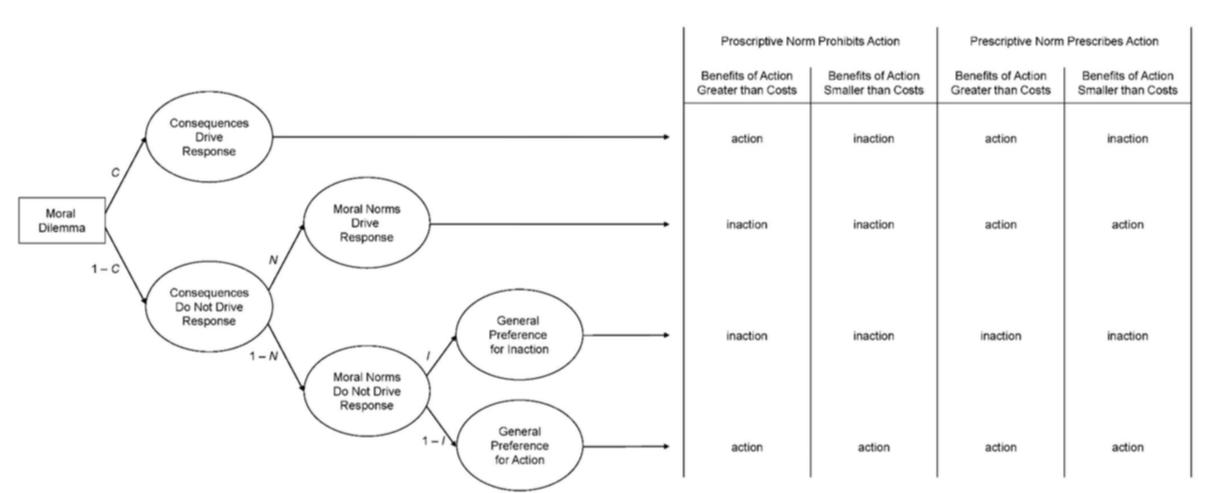
Gawronski et al, 2017 figure 1

insert-transcript#41b2dc1d-c182-4ba5-8a4c-00f9b060c4e7-here
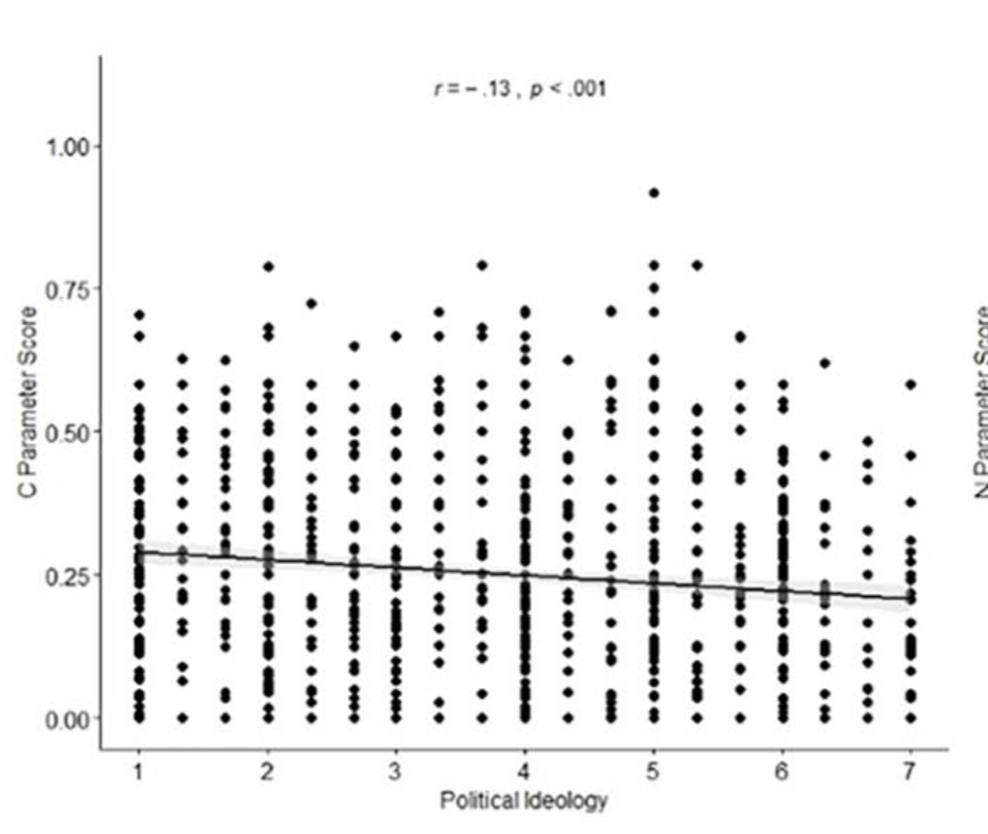
Luke & Gawronski (2021, p. figure 2 (part))

insert-transcript#be670ff6-92ce-4e68-9694-4ba4c9954c2d-here

‘on average, conservatives are

less inclined to accept harmful actions for the greater good

than liberals. [And] liberals are

more sensitive to the consequences of a given action for the greater good

than conservatives’

(Luke & Gawronski, 2021, p. 10)

insert-transcript#8fe7bee8-7723-44a0-b0ac-2dfadfac76c7-here

‘You can make a difference by recyling because you know it’s the right thing to do. Your actions can help care for others and allow the greatest good for society. Because of people like you, we can reduce the harm to others and to the environment by recycling. You CAN make a difference

‘You can join the fight by recycling with those like you in your community. Your actions can help us do our civic duty because recycling is the responsible thing to do in our society. Because of people like you, we can follow the advice of important leaders by recycling. You CAN join the fight!’

insert-transcript#8fed1769-9ab7-4f3b-bfd5-0493e1974d4f-here

problem 1: lack of scalar invariance

reply: process dissociation + MFQ-2

problem 2: Joan-Lars-Joseph Objection

partial reply: differences in moral psychology go beyond fairness and harm (L&G: consequences)

We still did not reply to the key insight: Luke & Gawronski (2021) only provide a comparison between liberals and conservatives. The Joan-Lars-Joseph Objection points out that we need evidence to show that within conservatives, binding foundations (or norm-based considerations) outrank individualizing foundations (or consequence-based considerations).
So Does Luke and Gawronski really answer the Joan–Lars–Joseph objection? Only partially. Their evidence shows a comparative difference between liberals and conservatives in consequence sensitivity. It does not by itself show that within conservatives, norm-based appeals outrank consequence-based appeals in exactly the way the objection demands.
Earlier we saw there are two things to explain: (1) [inter] why do liberals respond more strongly to harm- and fairness-based appeals than conservatives? and (2) [intra-conservatives] why do conservatives respond more strongly to loyalty-, authority-, and purity-based appeals than to harm- and fairness-based appeals?
Luke & Gawronski (2021) can help with (1) but not (2).
insert-transcript#ce7b9cf3-2490-405a-95ea-582ee5b13510-here

Why does moral reframing work?

hypothesis 1

match

There is cultural variation in moral foundations.

Reframing engages the morals of the target culture.

Moral engagement influences action.

hypothesis 2

source

Targets identify the source as an in-group

and so construe the message favourably

increasing willingness to act.

So where are we?
There is some variation, but what exactly it is variantion in— we should be more open on that. Maybe it’s not foundations exactly but willingness to consider consequences, or some further combination of factors. (Or maybe the idea about consequences is just another way of presenting fairness?)
insert-transcript#2601cf84-75e6-4e0c-a241-d78041276308-here

puzzle

If the evidence for cultural variation in moral psychology is at best weak,
and if the theoretical argument for moral reframing is flawed,
why does moral reframing seem to work?

Now that we have understood process dissociation, we have a better idea about the puzzle.
What solution did I propose? Is it correct?
Now we have evidence from MFQ-2 together with process dissociation. These are based on entirely different theoretical ideas but explain the same data.
So I want to say that the answer to the puzzle is that the evidence is not weak any more—it was weak, and so it was a lucky guess that moral reframing would work. But now we have a sounder evidential basis for it.
And although I think the theoretical argument might still need some work, it lacks any straightforward, obvious fatally flaws.
Importantly, though, I think we are quite far from understanding for sure how moral psychology varies between cultures.
At the very least, we should recognize that there is significant uncertainty about Moral Foundations Theory.