
Keyboard Shortcuts?f

×
  • Next step
  • Previous step
  • Skip this slide
  • Previous slide
  • mShow slide thumbnails
  • tShow transcript (+SHIFT = all transcript)
  • nShow notes (+SHIFT = all notes)

Please be cautious in using the transcripts.

They were created mechanically and have mostly not been checked or revised.

Here is how they were created:

  1. live lecture recorded;
  2. machine transcription of live recording;
  3. ask LLM to clean up transcript, and link to individual slides.

This is an error-prone process.

Click here and press the right key for the next slide.

(This may not work on mobile or ipad. You can try using chrome or firefox, but even that may fail. Sorry.)

also ...

Press the left key to go backwards (or swipe right)

Press n to toggle whether notes are shown (or add '?notes' to the url before the #)

Press m or double tap to slide thumbnails (menu)

Press ? at any time to show the keyboard shortcuts


Moral Intuitions and Emotions: Evaluating the Evidence

insert-transcript#eca62efb-8de9-4a6d-bf1d-950752d619dc-here

Q: What do adult humans compute that enables their moral intuitions to track moral attributes (such as wrongness)?

Hypothesis:

They rely on the ‘affect heuristic’: ‘if thinking about an act [...] makes you feel bad [...], then judge that it is morally wrong’.

But is the Hypothesis true?

Prediction:

If you make people feel bad without them realising it, they will be more inclined to judge that something is morally wrong.

Evidence:

Schnall et al., 2008

Schnall et al. (2008) report that experimentally induced *incidental* disgust (e.g., working at a disgusting desk) can make some participants render harsher moral judgments. Later work suggests this amplification effect is small (meta-analytic point estimate) and may be fragile; see \Landy & Goodwin, 2015.
‘(Schnall et al., 2008) probed subjects’ responses to moral scenarios featuring morally relevant actions such as eating one’s dead pet dog while priming subjects to feel disgusted. In one experiment, subjects filled out their questionnaires while seated at either a clean desk or a disgusting desk, stained and sticky and located near an overflowing waste bin containing used pizza boxes and dirty-looking tissues. Subjects who were rated as highly sensitive to their own bodily state were more likely to condemn the actions when seated at the disgusting desk than at the clean desk.’
1. Is it really evidence?
insert-transcript#252a3822-8771-4c78-8ba3-78ba304059bd-here

Has the study featured in a review? If so, does the review broadly support the findings of this study?

insert-transcript#b9682925-915a-42aa-b9cc-b22fd206d15c-here
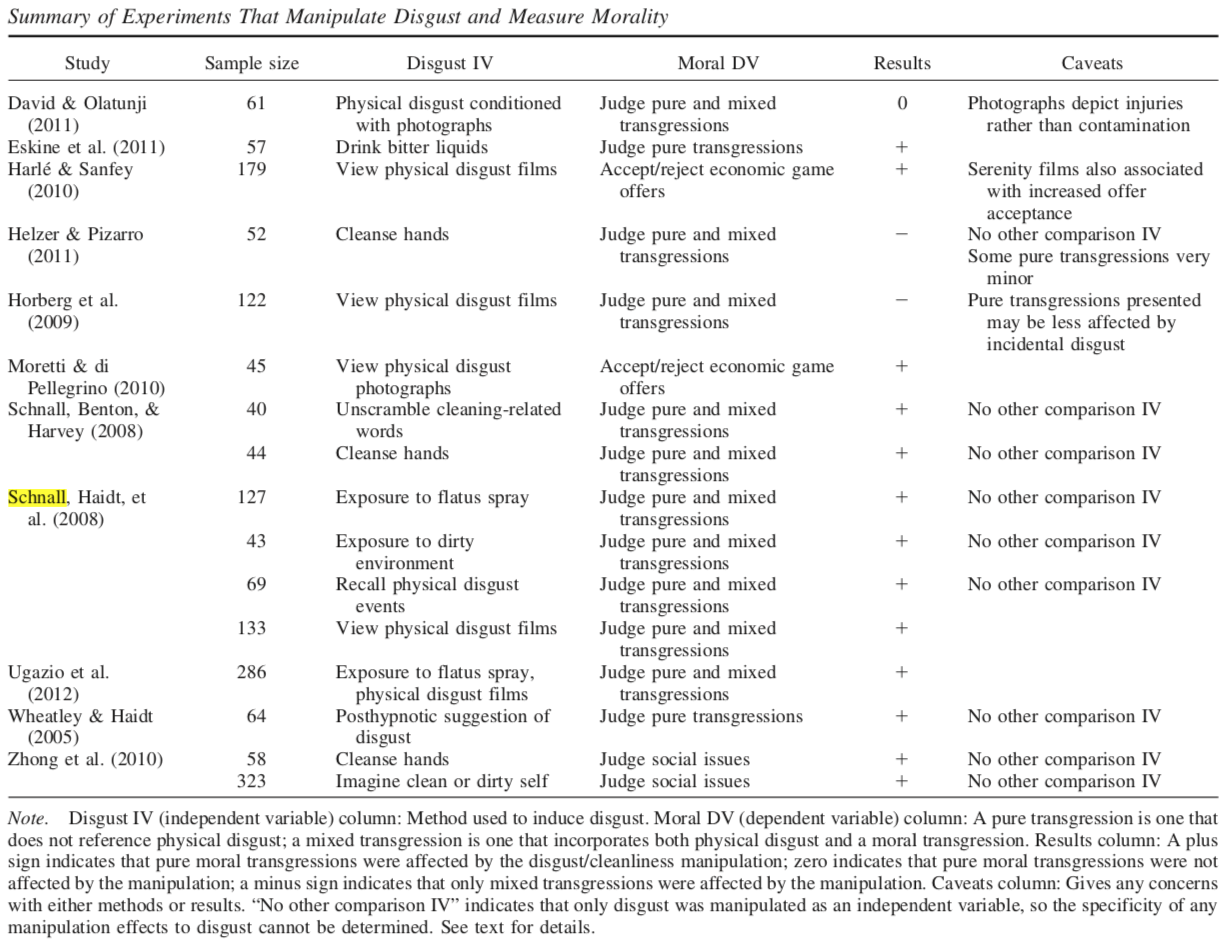
Chapman & Anderson, 2013 table 2

11 studies here. Note that two studies found no effect of manipulating disgust on moral judgement.

‘To date, almost all of the studies that have manipulated disgust or cleanliness have reported effects on moral judgment. These findings strengthen the case for a causal relationship between disgust and moral judgment, by showing that experimentally evoked disgust—or cleanliness, its opposite—can influence moral cognition’

Chapman & Anderson (2013, p. 313)

UPDATE

‘a recent meta-analysis of disgust induction studies suggests that incidental disgust has at best a small effect on moral judgment (Landy & Goodwin, 2015).’

Chapman (2018, pp. 73–4)

You might think: small effect, big effect, who cares as long as there is an effect. But ...
Landy & Goodwin (2015) argue that the effect is too small for Schnall, Haidt, Clore, & Jordan (2008)’s methods to have discovered, and therefore that we cannot rely on their findings.
∞todo update: But Salvo, Ottaviani, & Mancini (2025) offers a different conclusion. I am not sure why their findings are so different from Landy & Goodwin (2015)’s. [UPDATE have some notes on this; roughly, Landy and Goodwin are on the right track.]
insert-transcript#66064e3f-ed9d-4517-81b4-315164bb687a-here

Has the study featured in a review? If so, does the review broadly support the findings of this study?

insert-transcript#6bce3904-66cb-4412-839d-f11c83e143f9-here

Are there similar studies? If so, are the findings convergent?

Never trust a single study.
insert-transcript#7b46bac0-9938-483f-91d0-5f90e9a84a5f-here
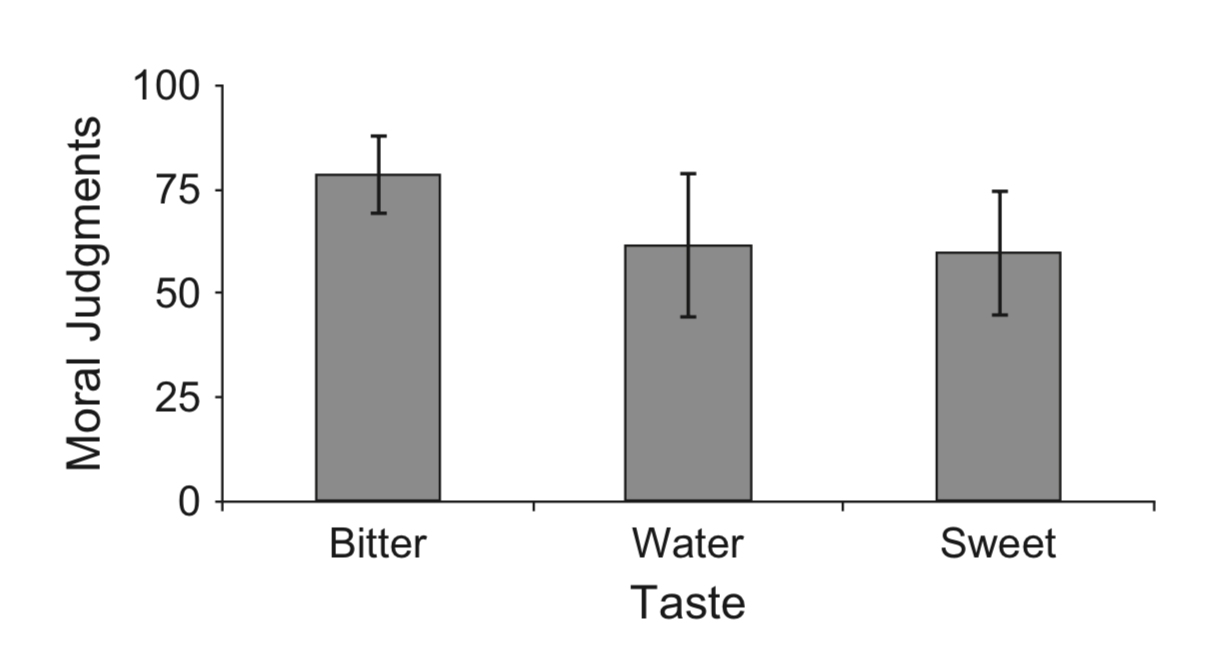
Eskine et al, 2011 figure 1

Eskine, Kacinik, & Prinz (2011) is another study which appears to support (and extend) Schnall et al. (2008).
Relevant because bitterness is related to disgust.
Different tastes in mouth, ‘using Wheatley and Haidt’s (2005) moral vignettes, which portray various moral trans- gressions (second cousins engaging in consensual incest, a man eating his already-dead dog, a congressman accepting bribes, a lawyer prowling hospitals for victims, a person shoplifting, and a student stealing library books)’ (Eskine et al., 2011).
Also ‘using Wheatley and Haidt’s (2005) moral vignettes, which portray various moral transgressions (second cousins engaging in consensual incest, a man eating his already-dead dog, a congressman accepting bribes, a lawyer prowling hospitals for victims, a person shop-lifting, and a student stealing library books)’ (Eskine et al., 2011).
‘Results revealed a significant effect of bev- erage type, F(2, 51) = 7.368, p = .002, η 2 = .224. Planned contrasts showed that participants’ moral judgments in the bitter condition (M = 78.34, SD = 10.83) were significantly harsher than judgments in the control condition (M = 61.58, SD = 16.88), t(51) = 3.117, p = .003, d = 1.09, and in the sweet condition (M = 59.58, SD = 16.70), t(51) = 3.609, p = .001, d = 1.22’ (Eskine et al., 2011).
‘Judgments in the control and sweet conditions did not differ significantly, t(51) = 0.405, n.s.’ (Eskine et al., 2011).

insert-transcript#90028036-301b-4d3e-b7c3-3387cd6fb78d-here

Are there similar studies? If so, are the findings convergent?

insert-transcript#1cd5bb27-a353-4954-af3a-3c682840d4a3-here

Has the study been replicated?

1 is a successful conceptual replication of \Wheatley & Haidt (2005) (good).

Ugazio, Lamm, & Singer (2012) report a failure to replicate Experiment 1 (but with an extraneous change in method).

Note that the same authors published another study in the same year (Schnall, Benton, & Harvey, 2008) which an attempt to replicate has quite convincingly indicated that the effect is not powerful enough to have been discovered by the original study (Johnson, Cheung, & Donnellan, 2014).

Johnson et al. (2016) report a convincing failure to replicate Experiment 3 (the one where participants recall a disgusting event in their own lives).

insert-transcript#fbd08f8d-aa13-44ef-8b09-cab50cffa001-here

Q: What do adult humans compute that enables their moral intuitions to track moral attributes (such as wrongness)?

Hypothesis:

They rely on the ‘affect heuristic’: ‘if thinking about an act [...] makes you feel bad [...], then judge that it is morally wrong’.

But is the Hypothesis true?

Prediction:

if you make people feel bad (/good) without them realising it, they will be more (/less) inclined to judge that something is morally wrong.

Evidence:

Schnall et al., 2008

Schnall et al. (2008) report that experimentally induced *incidental* disgust (e.g., working at a disgusting desk) can make some participants render harsher moral judgments. Later work suggests this amplification effect is small (meta-analytic point estimate) and may be fragile; see \Landy & Goodwin, 2015.
What should we conclude? Without closer evaluation of more experimental findings (which is surely worthwhile, although not for everybody), we should be cautious in taking Schnall, Haidt, et al. (2008) or similar studies as providing strong evidence that experimentally induced extraneous disgust makes people harsher in their moral judgements.
We should not infer that emotions and feelings do not influence moral intuitions at all. There are other ideas about how disgust and other feelings could influence emotion which are supported by other sources of evidence (for instance, Piazza, Landy, Chakroff, Young, & Wasserman, 2018).
insert-transcript#76f31dd1-a2a9-49e6-815d-2ccd00479fbf-here

How to evaluate a study

1. Never trust a philosopher.

2. Is it really evidence?

a. Has the study featured in a review? If so, does the review broadly support the findings of this study?

b. Are there similar studies? If so, are the findings convergent?

c. Has the study been replicated?

Aim to know that there is a supportive answer to at least one of these questions; the more questions that given supportive answers, the stronger the evidence.
Also, if there has been a failure to replicate a study whose results you are relying on, you should normally mention that and explain why you are nevertheless relying on those results.
insert-transcript#4e017ddb-0619-48f8-a37c-2b9a8631a947-here

Can we reject the Affect Hypothesis?

insert-transcript#6267eb5c-84f2-4470-926a-24691d5e4a31-here

Can we reject the Affect Hypothesis?

yes

It’s not just that there is a lack of evidence for it ...

... there is also positive evidence that disgust has at most a small effect on moral judgements (Landy & Goodwin, 2015).

no

small ≠ none

The Hypothesis is about intuition but the evidence is about judgement.

Small effect size may be due to less sensitive measures.

Newer research supports a link between disgust and moral judgement (e.g. Tracy, Steckler, & Heltzel, 2019)

Resume

You have a friend who has been trying to find a job lately without much success. [...] He decided to put some false information on his resume [...]. By doing this he ultimately managed to get hired, beating out several candidates who were actually more qualified than he. How wrong was it for your friend to put false information on his resume in order to help him find employment?

Source: This is the Resume vignette from Schnall, Haidt, et al. (2008, p. Experiment 1)
The apparent small effect size may be due to lack of methodological rigour in some studies.
insert-transcript#37990771-8ca3-4dca-8243-ddd7115ddfb5-here
Following the evidence takes us on a winding path. It’s easy to think that we will never get to the top of the mountain. Great persistence is needed.
Apparently contradictory evidence should not cause us to give up. It’s often when you find apparently contradictory evidence that you can be useful as a philosopher.
(My whole career has been based on using philosophical ideas to construct theories motivated by apparently contradictory evidence.)
image source: bing ai
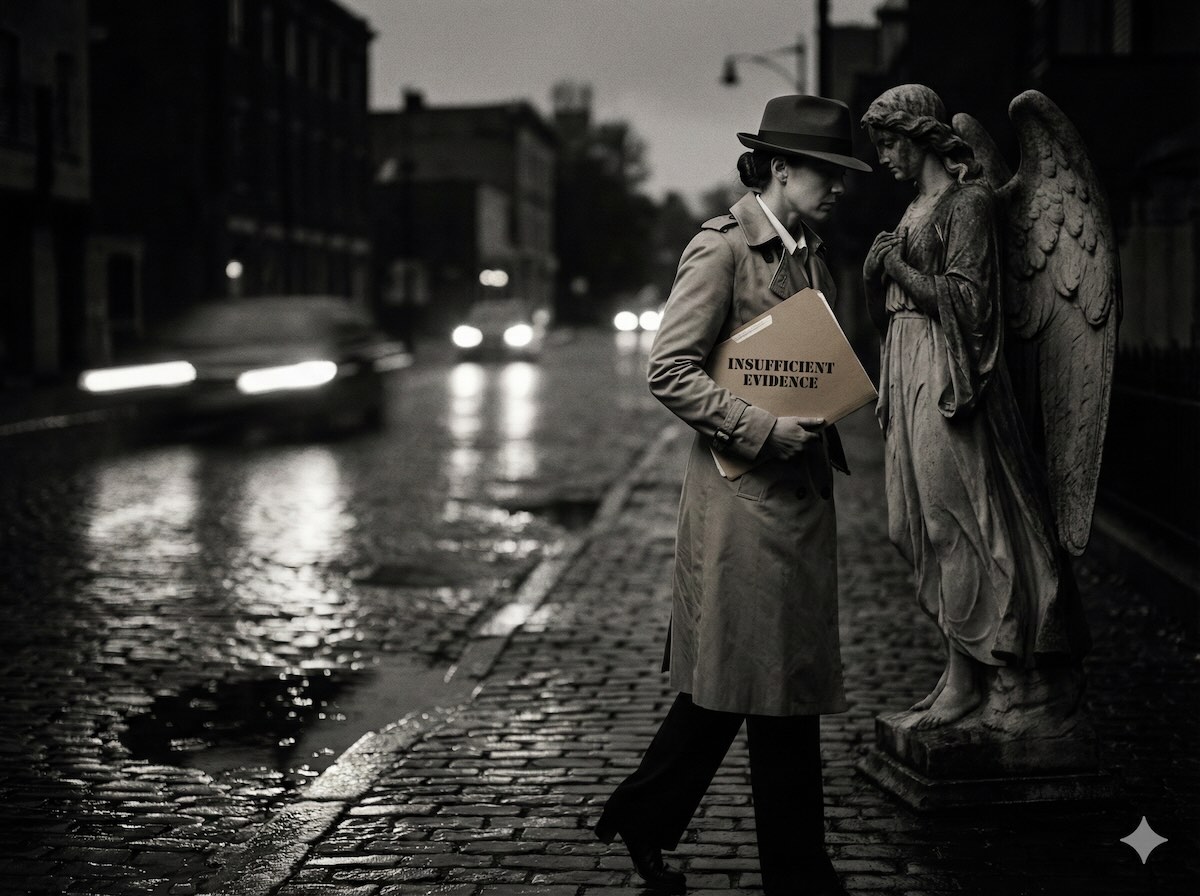
my job vs your job

Do not let the thesis of your essay be that there is insufficient evidence. (I knew that already.)
insert-transcript#8676eefa-b185-480d-ac75-a198b7901c51-here

What I will assume for the rest of the lectures ...

0. For now, we cannot rely on the results of Schnall, Haidt, et al. (2008).

1. Feelings of disgust can, and sometimes do, influence some moral intuitions (Tracy et al., 2019).

2. We feel disgust in response to moral transgressions.

insert-transcript#29f3735f-9c9b-4ee3-bcaf-9d19c08da350-here
Nice extension

Aside

Does disgust influence moral evaluations?

- Manipulate Disgust and Measure Morality (Tracy et al., 2019)

Are moral violations disgusting?

- Manipulate Morality and Measure Disgust (Chapman, Kim, Susskind, & Anderson, 2009)

insert-transcript#59e3017d-8d6a-43a5-99a8-54dd2471ec8b-here

What I will assume for the rest of the lectures.

0. For now, we cannot rely on the results of Schnall, Haidt, et al. (2008).

1. Feelings of disgust can, and sometimes do, influence moral intuitions.

2. We feel disgust in response to moral transgressions.

Also: we seem to need a better theoretical framework

insert-transcript#f01872c7-32fb-4e7c-ac00-f51b44d4f1d9-here
The Affect Heuristic I do not accept.
But I do accept the puzzle to which it is a response.
My conclusion: we need a better theory.

puzzle

Why do feelings of disgust sometimes influence moral intuitions?

(And why do we feel disgust in response to moral transgressions?)