Keyboard Shortcuts?f

×
  • Next step
  • Previous step
  • Skip this slide
  • Previous slide
  • mShow slide thumbnails
  • tShow transcript (+SHIFT = all transcript)
  • nShow notes (+SHIFT = all notes)

Please be cautious in using the transcripts.

They were created mechanically and have mostly not been checked or revised.

Here is how they were created:

  1. live lecture recorded;
  2. machine transcription of live recording;
  3. ask LLM to clean up transcript, and link to individual slides.

This is an error-prone process.

Click here and press the right key for the next slide.

(This may not work on mobile or ipad. You can try using chrome or firefox, but even that may fail. Sorry.)

also ...

Press the left key to go backwards (or swipe right)

Press n to toggle whether notes are shown (or add '?notes' to the url before the #)

Press m or double tap to slide thumbnails (menu)

Press ? at any time to show the keyboard shortcuts


Operationalising Moral Foundations Theory

insert-transcript#c65148be-85a0-46de-85e2-9d70a01a7f18-here

2

Moral-foundations researchers have investigated the similarities and differences in morality among individuals across cultures (Haidt & Joseph, 2004). These researchers have found evidence for five >1 fundamental domains of human morality

(Feinberg & Willer, 2013, p. 2)

So far we only talked about people having multiple, incommensurable ethical concerns (harm and purity).
Now we want to think about cultural differences.
I’m going to do this in a funny order. I will first explain the evidence and then say what the theory is.
This is because I think the evidence does not exactly support the theory (the theory is a bit too big).
It’s one of those interesting cases where it pays to work back from the evidence to what the theory should be, rather than simply accepting the theoretical claims of the researchers themselves.
insert-transcript#c400e357-688f-4d27-ae32-5a40b2c8bd48-here

Q

There may be cultural variations on what is, and what isn’t, an ethical issue.

So we can’t assume in advance that we know for sure what is ethical and what isn’t.

But if we don’t know what is ethical and what isn’t, how can we study cultural variations in it?

Big point: we want a method for identifying moral abilities that doesn’t depend on prior assumptions about what counts as ethical.
insert-transcript#1a76786a-a94e-4bb7-ba44-4b4f8110ef25-here
First step: anthropological research to identify potential domains, and to devise sets of questions that may represent each domain

individual foundations

harm/care, (in)equality, (dis)proportionality

was previously just cheating/fairness but updated in Atari et al. (2023)


binding foundations

betrayal/loyalty, subversion/authority, and impurity/purity

Graham et al. (2011), Atari et al. (2023)

Will focus just on these, full questionnaire is in the appendix
insert-transcript#91f32374-f45b-4bb4-ab63-b1277e1f56c7-here
From MFQ-2. Participants given statements and asked how strongly they agree or reject. These are examples for harm.
INSTRUCIONS: ‘For each of the statements below, please indicate how well each statement describes you or your opinions. Response options: Does not describe me at all (1); slightly describes me (2); moderately describes me (3); describes me fairly well (4); and describes me extremely well (5).’

care

I believe that compassion for those who are suffering is one of the most crucial virtues.

We should all care for people who are in emotional pain.

Everyone should try to comfort people who are going through something hard.
purity

People should try to use natural medicines rather than chemically identical human-made ones.

I think the human body should be treated like a temple, housing something sacred within.

I believe chastity is an important virtue.

(Atari et al., 2023)

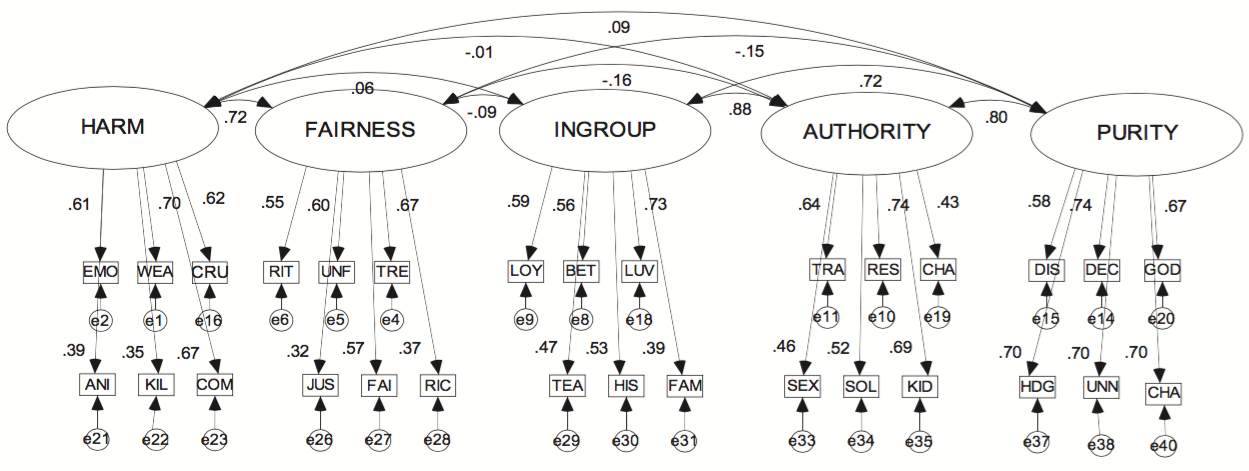
People’s views about care cluster together,

cluster together = statistically, there appears to be a single actor that explains them.

as do people’s views about purity;

and these two sets of views appear to be distinct.

appear to be distinct = statistically, distinct factors explain the sets of views.


This is called Confirmatory Factor Analysis. CFA
roughly, do answers to each category of questions appear to reflect a single and distinct underlying tendency, and is this tendency distinct from those that underlie answers to other questions?
insert-transcript#8c5551ae-d29e-4826-9998-19d28564506c-here

Atari et al. (2023, p. fig 1)

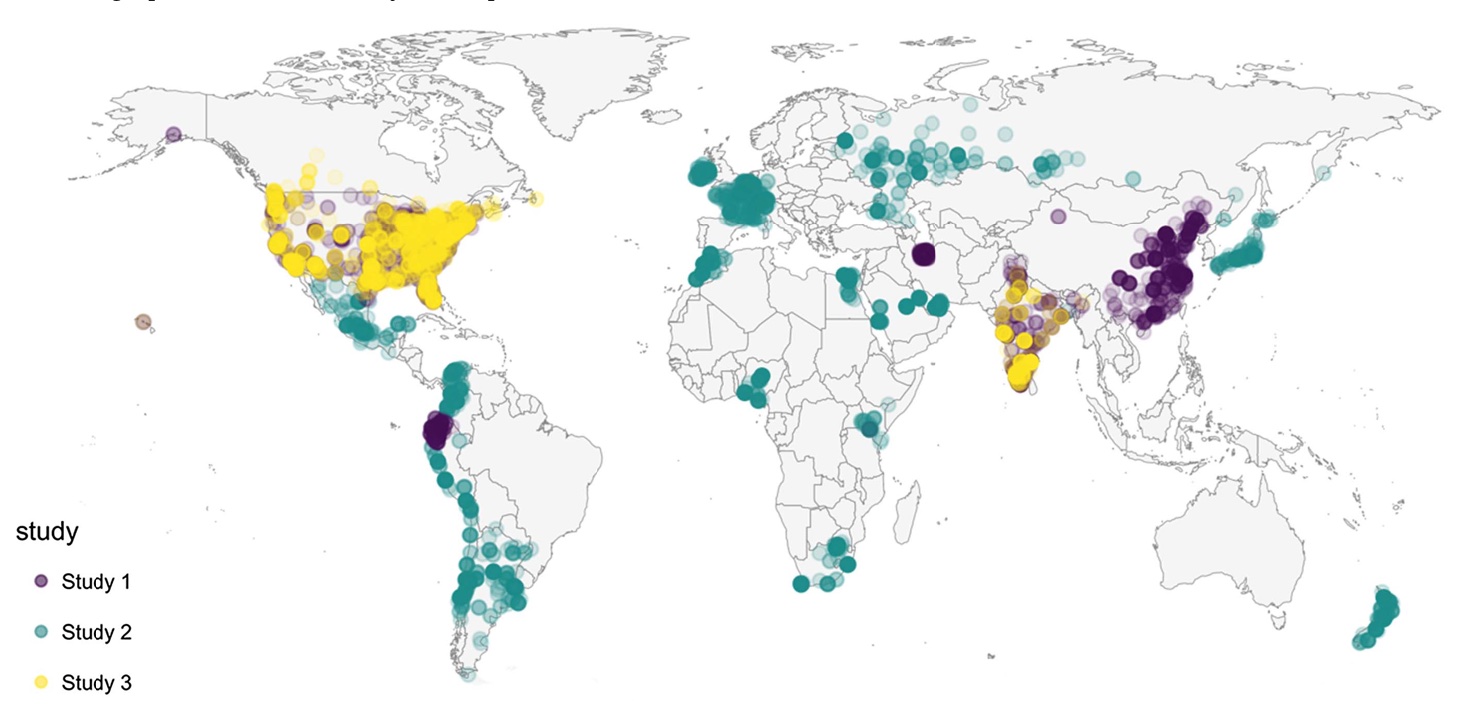
Importantly they included samples from a wide range of different places (internet samples tho)
insert-transcript#2adec8d7-ac7f-4d7c-af58-21cd9c3346e5-here

external validity

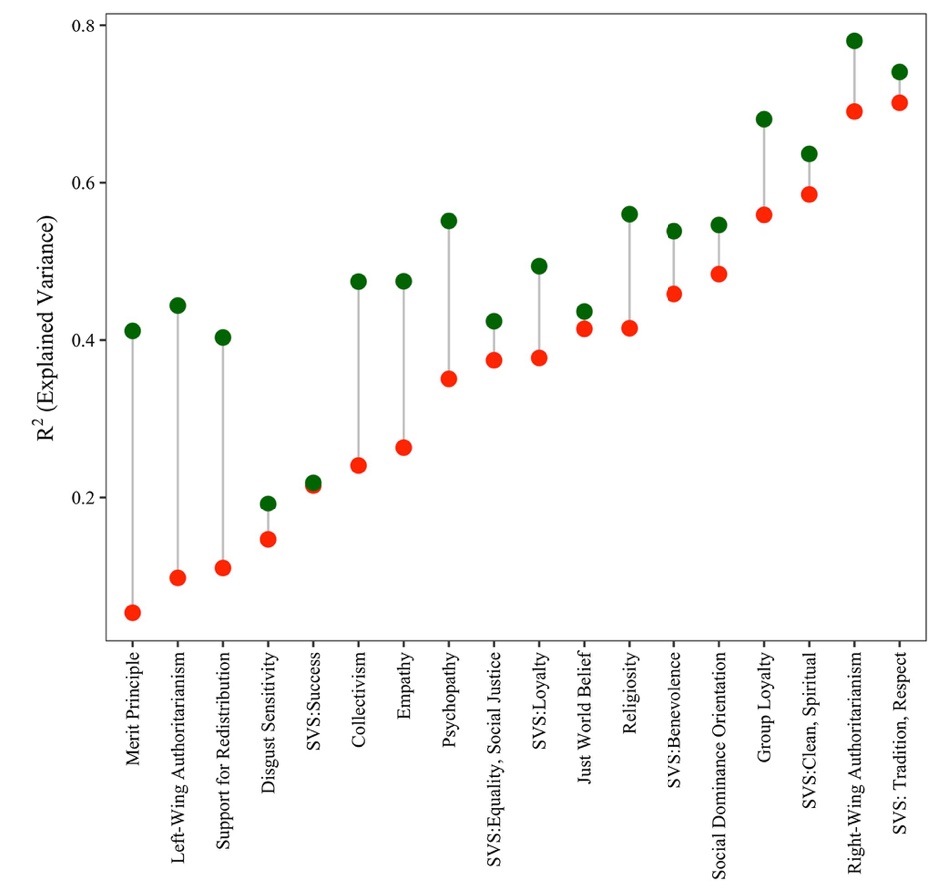
external validity - can you predict things that on theoretical grounds we might expect to be related?
insert-transcript#942efae9-17eb-45e0-9cb4-df5ea8eff4db-here
caption: ‘Red [=blue] dots represent explained variance in a model with MFQ-1 scores as predictors. Green [=white] dots represent explained variance in a model with all MFQ-2 and MFQ-1 scores as predictors. SVS = Schwartz Values Survey; MFQ = Moral Foundations Questionnaire.’

external validity

Atari et al. (2023, p. fig 8)

insert-transcript#5eac4983-651f-4911-9ee8-adc4fba422e6-here

Q

There may be cultural variations on what is, and what isn’t, an ethical issue.

So we can’t assume in advance that we know for sure what is ethical and what isn’t.

But if we don’t know what is ethical and what isn’t, how can we study cultural variations in it?
Have we answered this question?

fieldwork -> hypothetical model -> CFA -> revise model -> ...

We’ve made some progress—the idea is promising!
But there is one important further requirement ...
insert-transcript#c95634db-cd44-4231-89ea-bceef07f07c1-here
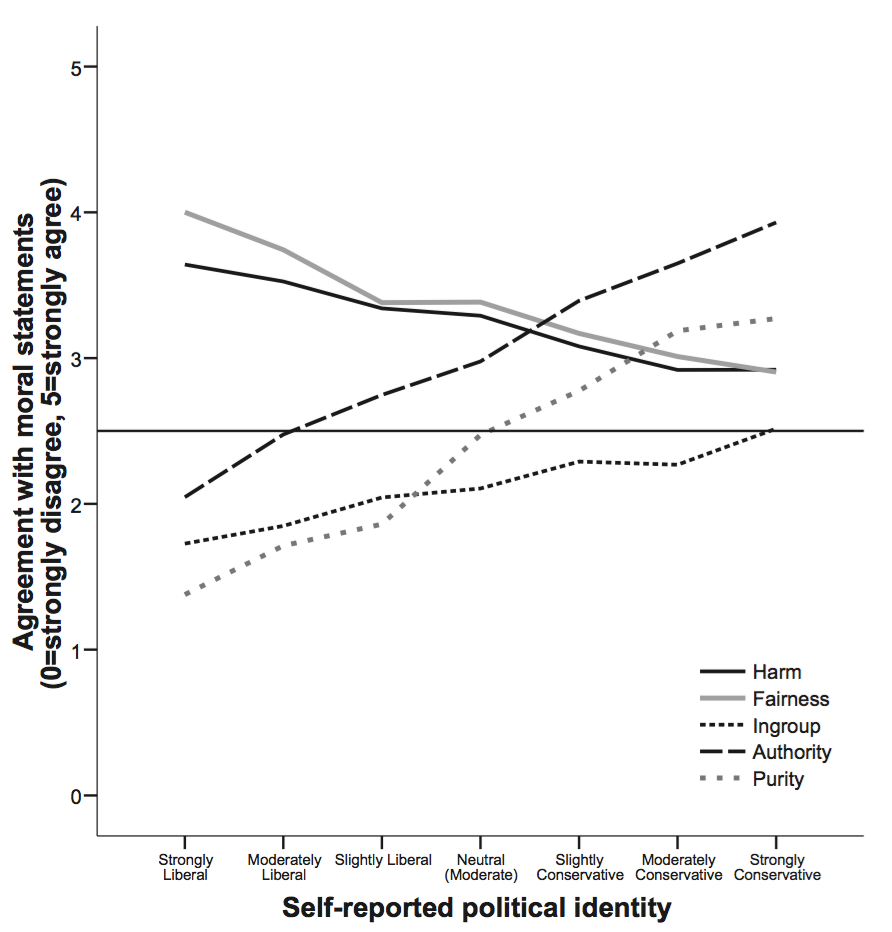
This is based on comparing means: it’s what you need (scalar) measurement invariance for

Graham et al, 2009 figure 3

Does this reflect
merely differences in how people interpret the questions
or substantial differences in their moral foundations?

insert-transcript#5d2739d1-ed23-4f5a-afb1-930bbbdc01d3-here

‘A finding of measurement invariance would provide more confidence that use of the MFQ across cultures can shed light on meaningful differences between cultures rather than merely reflecting the measurement properties of the MFQ’

(Iurino & Saucier, 2020, p. 2)
Compare Lee (2018): ‘Ascertaining scalar invariance allows you to substantiate multi-group comparisons of factor means (e.g., t-tests or ANOVA), and you can be confident that any statistically significant differences in group means are not due to differences in scale properties.’

Iurino & Saucier, 2018 p. 2

I’m not mentioning Iurino & Saucier, 2018’s study because they note some limits of their sample and methodology.

metric invariance - you can compare variances

scalar invariance - you can compare means (eg ‘conservatives put more weight on purity than liberals’)

insert-transcript#3baaa845-7ca1-46d8-890a-5abfcd61ea62-here

summary of requirements

model fit (CFA)

predictive power

measurement invariance

... and others (test-retest reliability, ...)

insert-transcript#ea22984d-9b00-4394-bbc1-71969748fa46-here

MFQ-2 : from 2023 (Atari et al., 2023; Dogruyol et al., 2024)

MFQ-1: from 2007 (Haidt & Graham, 2007)

Davis et al. (2016): no scalar invariance for Black people vs White people

(Davis et al., 2016) found metric but not scalar invariance

Atari, Graham, & Dehghani (2020): scalar non-invariance for US vs Iranian participants

Doğruyol, Alper, & Yilmaz (2019): metric non-invariance for WEIRD/non-WEIRD samples

‘the five-factor model of MFQ revealed a good fit to the data on both WEIRD and non-WEIRD samples. Besides, the five-factor model yielded a better fit to the data as compared to the two-factor model of MFQ. Measurement invariance test across samples validated factor structure for the five-factor model, yet a comparison of samples provided metric non-invariance implying that item loadings are different across groups [...] although the same statements tap into the same moral foundations in each case, the strength of the link between the statements and the foundations were different in WEIRD and non-WEIRD cultures’ (Doğruyol et al., 2019).

Nilsson (2023): non-invariance for class within Sweden

Iurino & Saucier (2020): problems with fit

Note that Haidt, Graham and colleagues have mostly ignored these problems in reviews. E.g. Graham et al. (2019) does not mention invariance at all.
insert-transcript#1b4ad34f-7957-4d12-92bf-553a1c9d7819-here

MFQ-1 (Graham, Haidt, & Nosek, 2009, p. Appendix B)

illustrate this with MFQ-1 item
From MFQ-1. Participants given statements and asked how strongly they agree or reject. These are examples for harm.

harm

If I saw a mother slapping her child, I would be outraged.

It can never be right to kill a human being.

Compassion for those who are suffering is the most crucial virtue.

The government must first and foremost protect all people from harm.

Might be high on harm but sceptical of government’s ability to do this without making things worse.

purity

People should not do things that are revolting to others, even if no one is harmed.

I would call some acts wrong on the grounds that they are unnatural or disgusting.

Chastity is still an important virtue for teenagers today, even if many don’t think it is.

The government should try to help people live virtuously and avoid sin.

If you find yourself in strong agreement with these, you are someone who treats purity as more important than someone who agrees less strongly.
Btw, this is MFQ-1 and it looks like there is a confound with religiosity.

‘some of the [...] items may conflate moral foundations with other constructs such as religiosity or racial identity.’ (Davis et al., 2016, p. e29)

insert-transcript#395dc0c8-f011-4600-b3f9-b7dbf057fc08-here

MFQ-2 : from 2023 (Atari et al., 2023; Dogruyol et al., 2024)

MFQ-1: from 2007 (Haidt & Graham, 2007)

Davis et al. (2016): no scalar invariance for Black people vs White people

(Davis et al., 2016) found metric but not scalar invariance

Atari et al. (2020): scalar non-invariance for US vs Iranian participants

Doğruyol et al. (2019): metric non-invariance for WEIRD/non-WEIRD samples

Nilsson (2023): non-invariance for class within Sweden

Iurino & Saucier (2020): problems with fit

insert-transcript#15e0cfc6-fe56-4089-80ba-fd5352b20cf7-here

summary of requirements

model fit (CFA)

predictive power

measurement invariance

... and others (test-retest reliability, ...)

insert-transcript#1888d342-cf15-4a96-bd5b-af42835c11e2-here
so far I was talking only about MFQ-1, which was used in all but the very latest study.

MFQ-2

fairness -> equality and proportionality (six factors)

Equality (which concerns equal treatment) and Proportionality (which concerns being rewarded in proportion to one’s contribution)
Also new questions to avoid conflating religious issues.

scalar invariance ?

Actually ... these researchers also demonstrate that the questionnaire (MFQ-2) does exhibit scalar invariance for only five of the six foundations—the exception is purity (p. 1167).

liberals differ from conservatives in scoring:

higher on care and equality

lower on proportionality, loyality, authority and purity

‘We conducted a random-intercept, multilevel model to predict political ideology based on all six moral foundations. We found care (B = −0.25, SE = 0.070, p < .001) and equality (B = −0.57, SE = 0.048, p < .001) to be negatively correlated with political conservatism, while proportionality (B = 0.30, SE = 0.075, p < .001), loyalty (B = 0.24, SE = 0.075, p = .001), authority (B = 0.55, SE = 0.087, p < .001), and purity (B = 0.13, SE = 0.063, p = .039) were positively associated with right-wing ideology. That care is associated with liberal ideology, and that loyalty, authority, and purity are associated with conservative ideology are consistent with prior work (Graham et al., 2009; Kivikangas et al., 2021; McAdams et al., 2008). We also present novel findings with regard to the differential relationships between two novel foundations and political ideology. In line with our theorizing and prior work, we find that liberals are more concerned with equality and conservatives are more concerned with proportionality.’ (Atari et al., 2023, p. 1171)

(Atari et al., 2023)

partial replication: Dogruyol et al. (2024)

insert-transcript#c10e2095-2a8a-40dc-8d58-e3b7a2bdde3e-here

Q

There may be cultural variations on what is, and what isn’t, an ethical issue.

So we can’t assume in advance that we know for sure what is ethical and what isn’t.

But if we don’t know what is ethical and what isn’t, how can we study cultural variations in it?

Have we answered this question?

fieldwork -> hypothetical model -> CFA -> revise model -> ...

So we were just checking that we can study cultural variations
insert-transcript#f124bf82-a945-440c-b8fd-cd10b80ea94b-here

2

Moral-foundations researchers have investigated the similarities and differences in morality among individuals across cultures (Haidt & Joseph, 2004). These researchers have found evidence for five >1 fundamental domains of human morality

(Feinberg & Willer, 2013, p. 2)

(Feinberg & Willer, 2013, p. 2)