Keyboard Shortcuts?f

×
  • Next step
  • Previous step
  • Skip this slide
  • Previous slide
  • mShow slide thumbnails
  • tShow transcript (+SHIFT = all transcript)
  • nShow notes (+SHIFT = all notes)

Please be cautious in using the transcripts.

They were created mechanically and have mostly not been checked or revised.

Here is how they were created:

  1. live lecture recorded;
  2. machine transcription of live recording;
  3. ask LLM to clean up transcript, and link to individual slides.

This is an error-prone process.

Click here and press the right key for the next slide.

(This may not work on mobile or ipad. You can try using chrome or firefox, but even that may fail. Sorry.)

also ...

Press the left key to go backwards (or swipe right)

Press n to toggle whether notes are shown (or add '?notes' to the url before the #)

Press m or double tap to slide thumbnails (menu)

Press ? at any time to show the keyboard shortcuts


A Linguistic Analogy

insert-transcript#1350c447-2e41-4ca5-a4d5-58a833a90ddd-here

previously: a hypothesis about the Affect Heuristic

now: an opposed hypothesis

insert-transcript#52edfa8a-6c72-480f-901e-b0328bec5f0e-here

moral intuitions

‘the central phenomena are moral emotions and intuitions.’

(Haidt, 2008, p. 65)

Q2 What do humans compute that enables them to track moral attributes?

Q1 How, if at all, do emotions influence moral intuitions?

linguistic intuitions

Some philosophers have invited us to compare ethical intuitions with linguistic intuitions.
insert-transcript#05909ea8-d6b7-475a-856b-86c4a30f918c-here
As fast as you can, which of the following two sentences is grammatical.

Which is a sentence?

[1] Many more people have been to Paris than I have.

[2] Many more Paris than have to been people I have.

insert-transcript#cab86f5b-e1ed-4d4a-bcb8-cad856c1aaba-here

moral intuitions

‘the central phenomena are moral emotions and intuitions.’

(Haidt, 2008, p. 65)

Q2 What do humans compute that enables them to track moral attributes?

Q1 How, if at all, do emotions influence moral intuitions?

linguistic intuitions

‘the central phenomena are moral emotions and intuitions.’

(Haidt, 2008, p. 65)

Q2 What do humans compute that enables them to track linguistic attributes?

Standard Answer: the linguistic attributes themselves, irrespective of whether they can articulate truths about them.

insert-transcript#084add07-2cbb-4e4c-9c1e-042bfe1fa54a-here

How could linguistic intuitions involve computing linguistic attributes if we are entirely unable to articulate even basic facts about them—and are even often wrong about them?

insert-transcript#7e0a732a-36b0-48e3-8d01-0bea6062ebcc-here

moral intuition

‘the mind contains a moral grammar: a complex and possibly domain-specific set of rules [...] this system enables individuals to determine the deontic status of an infinite variety of acts and omissions’

(Mikhail, 2007, p. 144)

Researchers who consider various analogies between linguistic and ethical abilities include Roedder & Harman (2010), Mikhail (2007), and Dwyer (2009).

linguistic intuition

linguistic competence involves a special-purpose module

which operates according to linguistic rules

What is a module? This is actually a huge topic in its own right. We might come back to it. For now, see handout.
First idea: there is a moral grammar
Second idea: the moral grammar is in the mind, as a module (not as a body of knowledge)
insert-transcript#25be7b54-e8b7-430f-9120-e5ce90cabad3-here

Note: a the linguistic analogy

There are many possible points of analogy. (See Roedder & Harman (2010) for a discussion.) Here we are making just one: the idea that there is a distinctive, special-purpose and modular capacity
insert-transcript#ee34733b-cd74-48a8-9fa3-c8879640bae9-here
What evidence might bear on this question.

What evidence might indicate that humans have a language ethics module?

dumbfounding (Dwyer, 2009)

resistance to revisability

structure implicit in moral intuitions (Mikhail, 2014)

insert-transcript#eddf7a0a-8752-44e9-a513-a2dc617a705d-here
Mikhail’s theoretical argument (reconstruction)

Do humans have a language ethics module?

1. ‘adequately specifying the kinds of harm that humans intuitively grasp requires a technical legal vocabulary’

Compare: ‘ concepts like battery, end, means and side effect [...] can [...] predict human moral intuitions in a huge number and variety of cases’ (Mikhail, 2007, p. 149).

therefore:

2. The abilities underpinning unreflective ethical judgements involve analysis in accordance with rules.

Mikhail, 2007

For now we are setting this idea up in opposition with the emotions idea. But actually they are not in opposition at all. Compare nonmoral disgust: it too can be based on a complex analysis of a situation.
Could ask whether conclusion follows from premise. But that’s not what I want to do. (Clearly not supposed to be deductive. Issue is whether the premise makes the conclusion more probable.)
Important to separate two kinds of analogy, tacit rules vs productivity:
(iii) Tacit, hard-to-articulate rules │ “L3: Language-speakers obey many esoteric rules that they themselves │ typically cannot articulate or explain…” (SEP, sep:experimental-moral#2-4- │ another-example-the-linguistic-analogy ) │ “M3: Moral agents judge according to esoteric rules (such as the │ doctrine of double effect) that they themselves typically cannot │ articulate or explain…” (SEP, sep:experimental-moral#2-4-another-example- │ the- │ linguistic-analogy )
(iv) Productivity / (near-)infinite evaluation of novel cases │ “L4: Drawing on a limited vocabulary, a speaker can both produce and │ comprehend a potential infinity of linguistic expressions.” (SEP, │ sep:experimental-moral#2-4-another-example-the-linguistic-analogy ) │ “M4: Drawing on a limited moral vocabulary, an agent can produce and │ evaluate a very large (though perhaps not infinite) class of │ action-plans, which are ripe for moral judgment.” (SEP, sep:experimental- │ moral#2-4-another-example-the-linguistic-analogy )
insert-transcript#8efa4074-99e8-4a7e-9b28-87d08373511a-here

Trolley

A runaway trolley is about to run over and kill five people. You can hit a switch that will divert the trolley onto a different set of tracks where it will kill only one.

Is it okay to hit the switch?

insert-transcript#e4b59a9d-b9e5-494c-ae56-6828fa117e3b-here

Trolley

\emph{Trolley}

A runaway trolley is about to run over and kill five people. You can hit a switch that will divert the trolley onto a different set of tracks where it will kill only one.

Is it okay to hit the switch?

Transplant

\emph{Transplant}

Five people are going to die but you can save them all by cutting up one healthy person and distributing her organs.

Is it ok to cut her up?

Why do people respond differently?

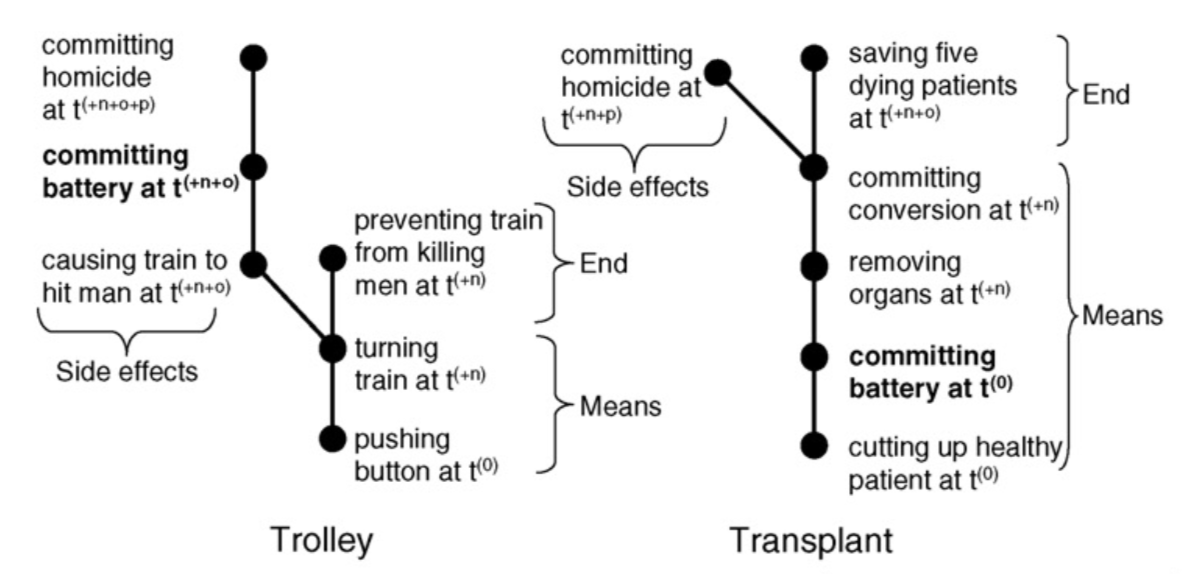
Mikhail, 2007; 2014: because one involves battery as a means
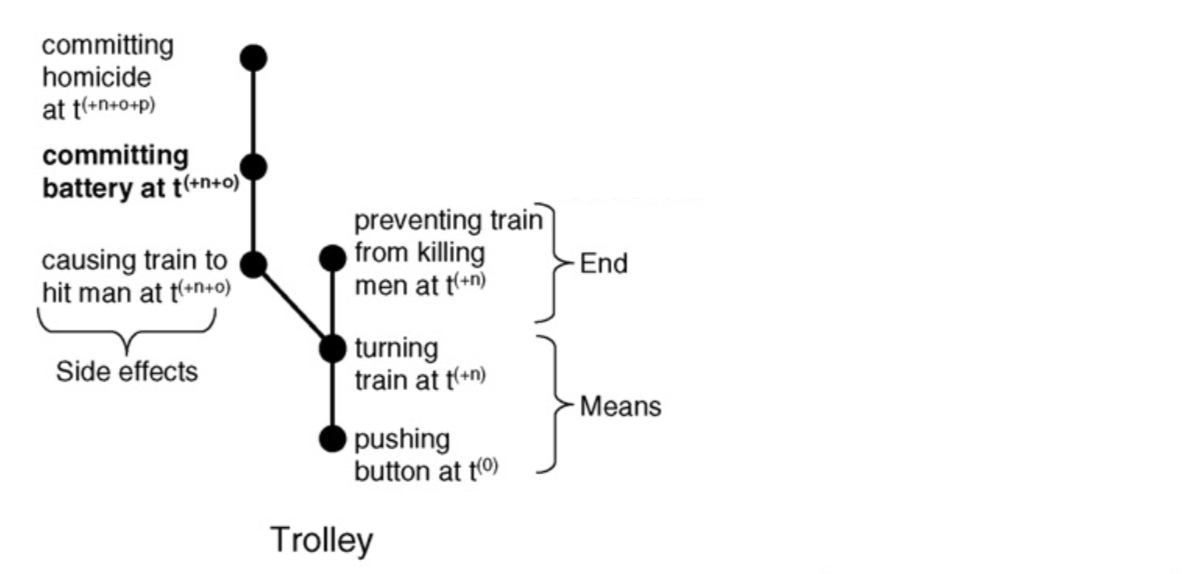
But crucially this depends on analysing the structure ...
insert-transcript#29f944b1-f955-4e0d-bedb-473315f97588-here

Mikhail, 2007 figure 1d (part)

(read this from bottom to top)
‘the Transplant and Trolley findings can be partly explained in terms of the distinction between battery as a means and battery as a side effect’ (Mikhail, 2007)
insert-transcript#994239a7-87dd-4b8f-9692-f44e4405f4f4-here

Mikhail, 2007 figure 1d

insert-transcript#7f75c73c-1feb-4c6a-b293-9eee8a8d398a-here

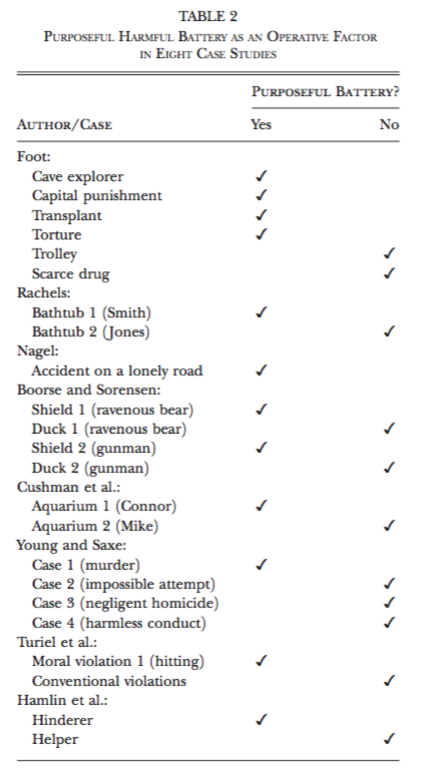
Mikhail, 2014 table 2

Mikhail extends his analysis to many further cases where philosophers or cognitive scientists have identifed an apparently inexplicable contrast.

Mikhail’s theses:

The contrasts make sense from a legal point of view,
so there is no need to suppose incompatible ethical principles are applied.

Many patterns in our intuitions are well predicted by legal distinctions (e.g., battery as a means vs as a side effect).

insert-transcript#2c1cc5c4-aecb-44d0-b844-16ede07046ce-here
Mikhail’s theoretical argument (reconstruction)

Do humans have a language ethics module?

1. ‘adequately specifying the kinds of harm that humans intuitively grasp requires a technical legal vocabulary’

Compare: ‘ concepts like battery, end, means and side effect [...] can [...] predict human moral intuitions in a huge number and variety of cases’ (Mikhail, 2007, p. 149).

Therefore:

2. The abilities underpinning unreflective ethical judgements involve analysis in accordance with rules.

Mikhail, 2007

So that was an argument for premise 1.
So this was one argument for the claim ...
insert-transcript#d39d26ad-d525-4ce3-9498-d7fc68116e24-here
The important thing for me isn’t whether you find the argument compelling or not. There’s surely much more to say. It’s that the motivation for it gives us a good question, a puzzle even.
Of course it’s important to know that this puzzle is considered to provide a basis for an argument for Mikhail’s Linguistic Analogy. One *candidate* answer to the puzzle is that we have module for representing actions in morally relevant terms.

puzzle

Why do patterns in humans’ moral intuitions reflect legal principles they are unaware of?

insert-transcript#ed4db2bc-2c1f-4dd8-8c55-8e964b970f22-here
What evidence might bear on this question.

What evidence might indicate that humans have a language ethics module?

dumbfounding

resistance to revisability

structure implicit in moral intuitions

insert-transcript#6e154dfd-8a26-440d-a64f-696cd2c8a40d-here

language

linguistic competence involves a special-purpose module

which operates according to linguistic rules

ethics

‘the mind contains a moral grammar: a complex and possibly domain-specific set of rules [...] this system enables individuals to determine the deontic status of an infinite variety of acts and omissions’

Mikhail, 2007 p. 144

(Mikhail, 2007, p. 144)
insert-transcript#840bbc73-d2ca-457d-a5f6-09e195e193cb-here

Affect Heuristic

Linguistic Analogy

Q2 What do humans compute that enables them to track moral attributes?

their felt responses to situations

moral attributes themselves

Q1 How, if at all, do emotions influence moral intuitions?

Moral intuitions are entirely determined by emotions.

Emotions do not influence moral intuitions at all.

So we have two major theories now.
Which give different answers to ...
... both questions.
Importantly, we also have good but not entirely convincing arguments for both theories.

fun fact: the evidence conflicts with both views

Evidence of a small but significant effect is in tension with a *strong* version of the linguistic analogy on which emotions play no causal role in moral intuitions and in tension with a *strong* Affect Heuristic hypothesis on which moral intuitions are *entirely* determined by incidental feelings.
insert-transcript#66321f40-97e9-40c1-a335-ed90fc893bf1-here
Why say the evidence conflicts with both views? because of the twin puzzles ...
feelings puzzle -> not Mikhail
structure puzzle -> not affect heuristic

puzzle

Why do feelings of disgust sometimes influence moral intuitions?

(And why do we feel disgust in response to moral transgressions?)

puzzle

Why do patterns in moral intuitions reflect legal principles humans are typically unaware of?