Click here and press the right key for the next slide.
(This may not work on mobile or ipad. You can try using chrome or firefox, but even that may fail. Sorry.)
also ...
Press the left key to go backwards (or swipe right)
Press n to toggle whether notes are shown (or add '?notes' to the url before the #)
Press m or double tap to slide thumbnails (menu)
Press ? at any time to show the keyboard shortcuts
Framing Effects: Emotion and Order of Presentation
Thomson’s method
[premise] There is a morally relevant difference between David and Edward.
[premise] There is no morally relevant difference between Edward and Frank.
[premise] ...
[conclusion] Thomson’s principle better explains the moral facts than Foot’s principle.
(how) do I know?
Not by inference. The premise is noninferentially justified (if it is justified at all).
‘One's intuitions are, I think, fairly sharp on these matters’ (Thomson, 1976, p. 207).
THESIS ‘no moral Intuitions are justified noninferentially’
(Sinnott-Armstrong, 2008, p. 74)
ARGUMENT
‘Evidence of framing effects
makes it reasonable [...] to assign a large probability of error to moral intuitions in general
and then
to apply that probability to a particular moral intuition
until they have [...] reason to believe that the particular moral intuition [has] a smaller probability of error’
(Sinnott-Armstrong, 2008b, p. 99).
[Another, complementary argument: Rini (2013)]
Does the evidence of framing effects successfully undermine the view that, as things stand, philosophers’ noninferentially justified moral judgements can yield knowledge?
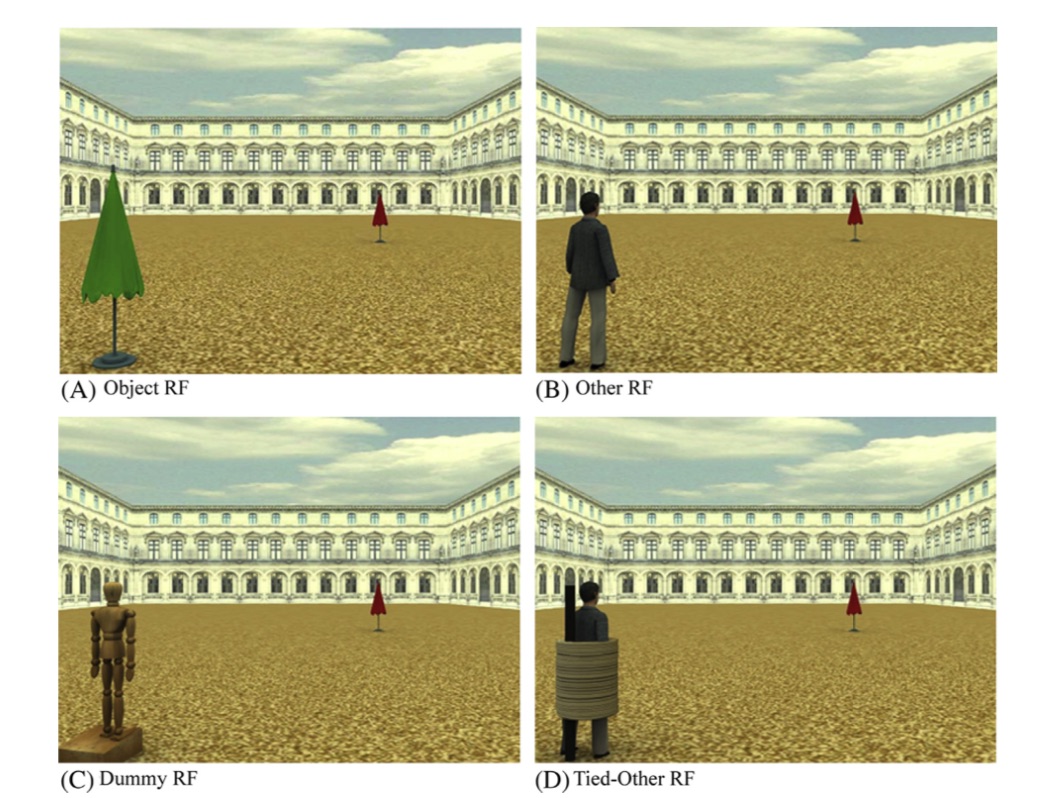
Fini, Brass, & Committeri (2015, p. figure 1)
Does the evidence of framing effects successfully undermine the view that, as things stand, philosophers’ noninferentially justified moral judgements can yield knowledge?
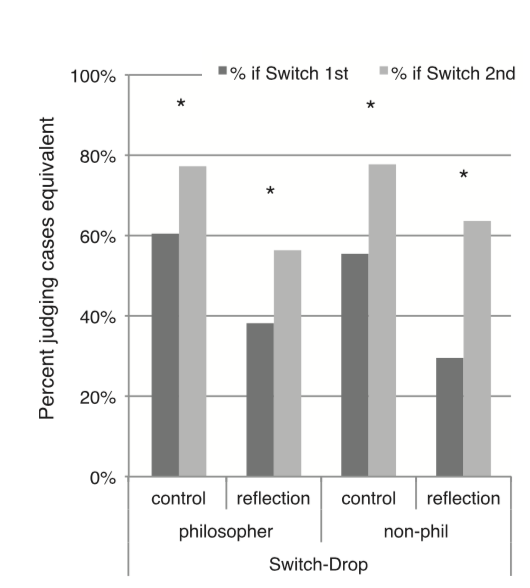
Schwitzgebel & Cushman, 2015 figure 2 (part)
order-of-presentation effects (Schwitzgebel & Cushman, 2015)
additional irrelevant options (Wiegmann, Horvath, & Meyer, 2020)
‘Asian disease’ (Prospect) framing (Wiegmann & Horvath, 2021)
Does the evidence of framing effects successfully undermine the view that, as things stand, philosophers’ noninferentially justified moral judgements can yield knowledge?
Why are there order-of-presentation effects?
Because one scenario selectively highlights an aspect of the causal structure of another scenario?
Wiegmann & Waldmann (2014)
ethical
judgements
spatial
judgements
financial
judgements
...
In certain other cases
‘there is no underlying preference that is masked or distorted by the frame. Our preferences are about framed problems, and our moral intuitions are about descriptions, not about substance’
(Kahneman, 2013).
‘expert ethicists have a genuine advantage over laypeople with respect to some well-known biases’
(Wiegmann & Horvath, 2021)
[premise] There is a morally relevant difference between David and Edward.
[premise] There is no morally relevant difference between Edward and Frank.
None of the framing effects yet discovered explain why we make these particular patterns of judgement.
Therefore a noninferentially justified judgement can be knowledge (for all we know).
THESIS ‘no moral Intuitions are justified noninferentially’
(Sinnott-Armstrong, 2008a, p. 74)
ARGUMENT
‘Evidence of framing effects
makes it reasonable [...] to assign a large probability of error to moral intuitions in general
and then
to apply that probability to a particular moral intuition
until they have [...] reason to believe that the particular moral intuition [has] a smaller probability of error’
(Sinnott-Armstrong, 2008b, p. 99).
[Another, complementary argument: Rini (2013)]
no
Thomson’s method
[premise] There is a morally relevant difference between David and Edward.
[premise] There is no morally relevant difference between Edward and Frank.
[premise] ...
[conclusion] Thomson’s principle better explains the moral facts than Foot’s principle.
(how) do I know?

a deeper understanding