
Keyboard Shortcuts?f

×
  • Next step
  • Previous step
  • Skip this slide
  • Previous slide
  • mShow slide thumbnails
  • tShow transcript (+SHIFT = all transcript)
  • nShow notes (+SHIFT = all notes)

Please be cautious in using the transcripts.

They were created mechanically and have mostly not been checked or revised.

Here is how they were created:

  1. live lecture recorded;
  2. machine transcription of live recording;
  3. ask LLM to clean up transcript, and link to individual slides.

This is an error-prone process.

Click here and press the right key for the next slide.

(This may not work on mobile or ipad. You can try using chrome or firefox, but even that may fail. Sorry.)

also ...

Press the left key to go backwards (or swipe right)

Press n to toggle whether notes are shown (or add '?notes' to the url before the #)

Press m or double tap to slide thumbnails (menu)

Press ? at any time to show the keyboard shortcuts


Do Ethical Attitudes Shape Political Behaviours?

insert-transcript#a6cd31bc-d109-4314-accd-5b6b2dea54a4-here
As background to the issue about moral psychology and climate change, we first want to look at a more general question. Do ethical attitudes shape political behaviours? (If this is not true, then we risk barking up the wrong tree with climate change.)

1

Moral convictions and the emotions they evoke shape explain political attitudes and behaviours (Emler, 2003; Mullen & Skitka, 2006; Skitka, Bauman, & Sargis, 2005)’

Feinberg & Willer (2013, p. 1)

what does this mean?
Feinberg & Willer’s claim is about attitudes; we’ll consider both attitudes and behaviours because (a) attitudes often poorly predict behaviours; (b) the climate-change question ultimately concerns behaviour/policy.
A conviction is an attitude. (This matters because a lot of what follows will be about attitudes.)
ok, let’s take a look ...
insert-transcript#c1efa894-c867-4cf0-aa21-29e8cf27afcf-here

strong, not moral

sports, music, clothes, starsign, ...

strong and moral

infaticide, female circumcision, abortion

- extremity

- importance

- centrality

- certainty

- ...

‘People’s feelings about various sports teams, their musical tastes, or even their relative preference for Mac versus PC operating systems could each easily be experienced as strong attitudes (extreme, certain, etc.), but would rarely be experienced as moral. People’s feelings about infanticide, female circumcision, abortion, or a host of political issues (gay marriage, the Iraq War, the Patriot Act), however, could be experienced as both strong and moral.’ (Skitka & Bauman, 2008, p. 31)
insert-transcript#9203761d-edab-4bca-bcb6-1014fa42acff-here

Skitka, Bauman, & Sargis, 2005

Does an attitude being moral have effects
beyond what can be explained by its strength alone?

‘we conducted four studies that examined whether strength of moral conviction predicted unique variance beyond other indices of attitude strength, such as attitude extremity, importance, certainty, and centrality, on a number of interpersonal measures’ (Skitka, Bauman, & Sargis, 2005, p. 895)

more dissimmilar ⨯ more moral -> prefer greater distance ?

- social distance [Studies 1 & 2]

- physical distance [Study 3]

‘exploring whether people prefer greater social [studies 1 & 2; and physical: study 3] distance from attitudinally dissimilar others when the attitude domain was held with high rather than low moral conviction’ (Skitka et al., 2005, p. 899)
Study 1 measures, simplified:
[1] ‘attitude strength’: ‘the questionnaire asked how strongly participants felt about their identified problem (extremity), how important it was to them personally (importance), and how much it was related to how they see themselves as a person (centrality) on 5-point radio button2 scales with the point labels of not at all, slightly, moderately, much, and very much.‘
[2] ‘Moral conviction. Moral conviction was assessed with a single-item measure, specifically, “How much are your feelings about ______ connected to your core moral beliefs or convictions?” on a 5-point radio button scale with the point labels of not at all, slightly, moderately, much, and very much, where the blank was filled in with the participant’s self-reported most important issue.’
[3] Social distance. ‘Participants were asked the degree that they agreed or disagreed with different completions to the stem “I would be happy to have someone who did not share my views on (their identified most important issue) . . .”; sentence completions were “as President of the U.S.,” “as Governor of my state,” “as a neighbor,” “to come and work at the same place I do,” “as aroom mate,” “to marry into my family,” “as someone I would personally date,” “as my personal physician,” “as a close personal friend,” “as the owner of a store or restaurant I frequent,” “as the teacher of my children,” and “as my spiritual advisor.” Participants responded on 7-point radio button scales with the point labels of very much agree, moderately agree, slightly agree, uncertain, slightly disagree, moderately disagree, and very much disagree. (Skitka et al., 2005, p. 899)
insert-transcript#7739bfcc-6b6d-4fbe-bc56-6529f042c7b1-here
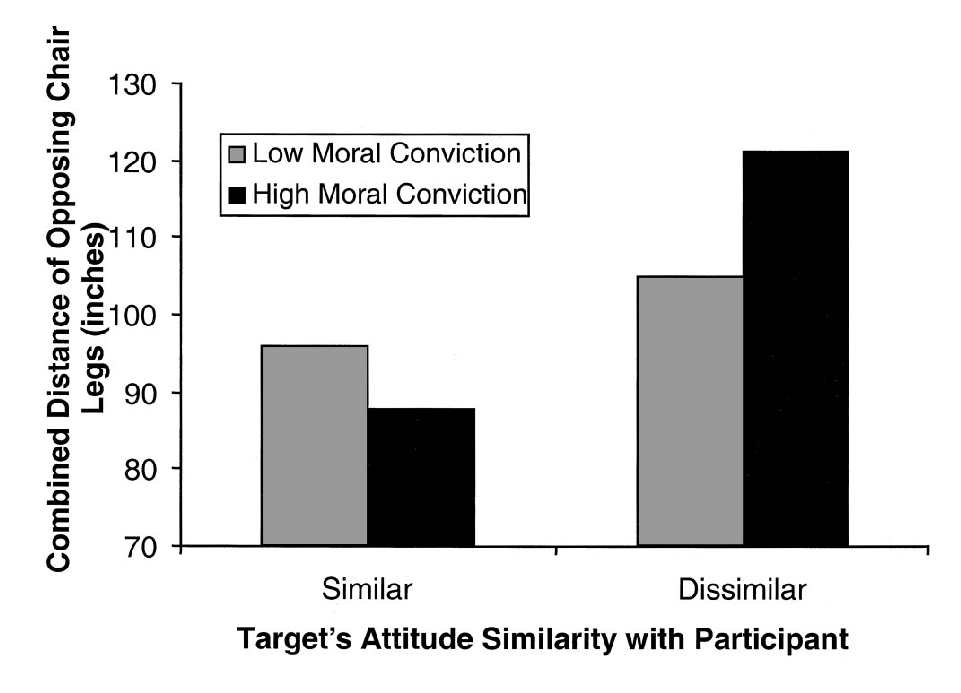
Skitka et al. (2005, p. figure~1)

This is study 3 (physical distance)
Skitka et al. (2005) found a significant interaction between moral conviction and attitude similarity/dissimilarity regarding physical distance
caption: ‘Average distance of participants’ chair placement from a strongly pro-choice target as a function of participants’ attitude similarity or dissimilarity with the target and participants’ strength of moral conviction in Study 3.’
the ‘moral conviction’ was measured by asking ‘“My attitude about abortion is closely tied to how I see myself as a person” on a 7-point radio button scale’
Only one attitude in Study 3: ‘Attitude similarity–dissimilarity was operationalized as participants’ responses to the question, “Do you generally support or oppose allowing abortion to remain a legal option in the U. S.?” ’

interaction

We say there is an interaction when the effect of one thing on another thing depends on a third thing.
In this case: strength of disagreement has an effect on physical distance, but the size of that effect depends on moral conviction.
The relationship between Disagreement and Distance changed entirely based on Moral Conviction.
insert-transcript#79020df4-80c7-41c5-a061-ab3b42004b5c-here

Skitka, Bauman, & Sargis, 2005

Results of Study 1:

‘The effect of moral conviction on social distance was robust when we controlled for the effects gender, age, attitudinal extremity, importance, and centrality’

(Skitka et al., 2005, p. 901)

‘In contrast, participants were more tolerant of having a distant than an intimate relationship with an attitudinally dissimilar other, when the attitude dissimilarity was on an issue that the participant held with low moral conviction, results that held even when we controlled for attitude strength.’

(Skitka et al., 2005, p. 901)
insert-transcript#288941cd-c619-4625-af90-49c1fd5e4fd5-here

Background:

‘Moral convictions and the emotions they evoke shape political attitudes (Emler, 2003; Mullen & Skitka, 2006; Skitka, Bauman, & Sargis, 2005)’

(Feinberg & Willer, 2013, p. 1)

Feinberg & Willer, 2013 p. 1

We were taking a look at this reference. Does it support the authors’ claim? Not obviously. But I want you to think about it
For what it’s worth, I’m not satisfied. moral attitudes predict preferences for social and physical distance: seems only indirectly related to politics. (Politics is life.)
If you were to write this and cite this in your essay, I would expect an explanation. What is the connection between social or physical distance and political attitudes you are making?

distance -> political attitude ???

insert-transcript#039a062d-e7da-4df4-9b1c-4ec7131fefaf-here

Never trust a philosopher scientist.

insert-transcript#787d73b0-d9e5-45d8-b4a3-40c41efb386a-here

1

Moral convictions and the emotions they evoke shape political attitudes’ and behaviours(Emler, 2003; Mullen & Skitka, 2006; Skitka, Bauman, & Sargis, 2005)’

Feinberg & Willer (2013, p. 1)

steps

1. Nonmoral attitudes (or convictions) do not ...

2. Moral attitudes (or convictions) do ...

insert-transcript#ce013d08-f4b3-48f2-99ae-4d77dcfee153-here
background: effect size

Sullivan & Feinn (2012) is a good source.
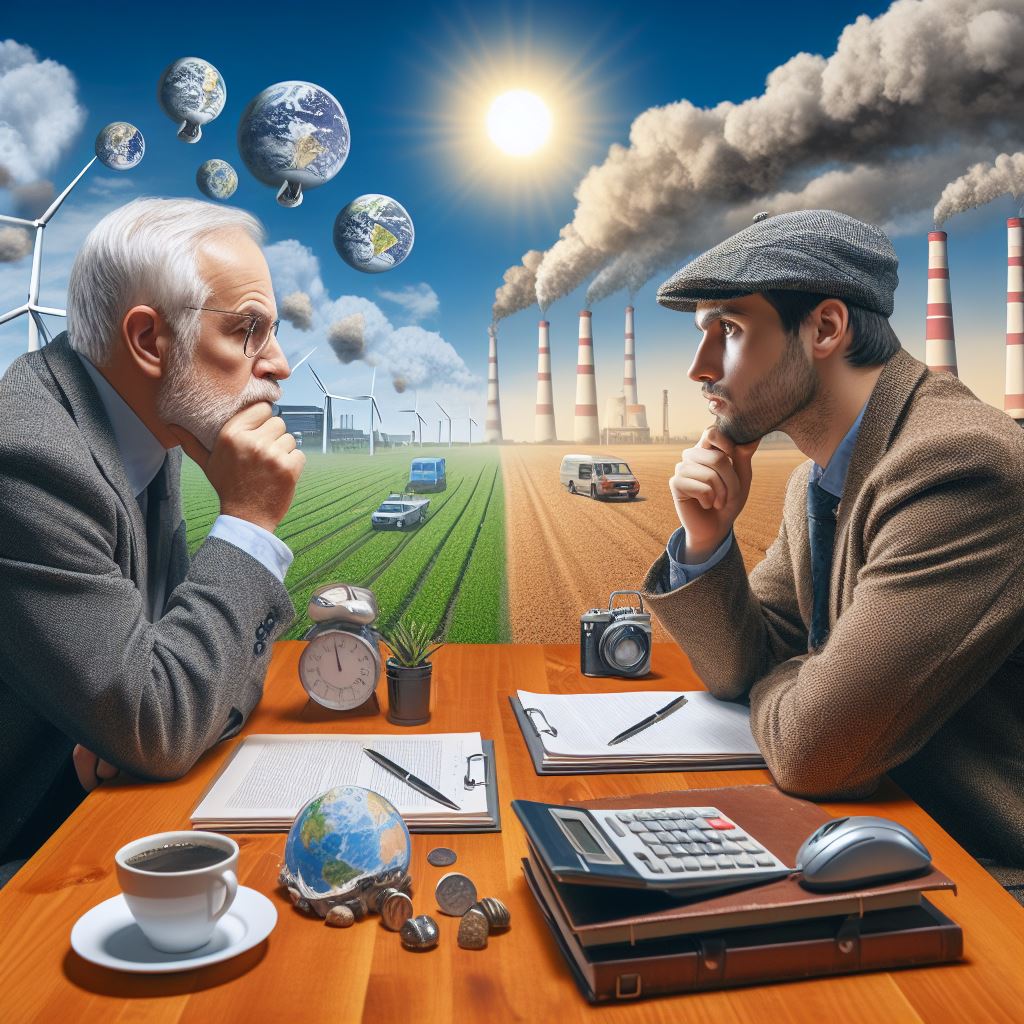
So you are working at VW and you want to know how many people your fraudlent faking of emissions tests will kill.
image source: bing ai
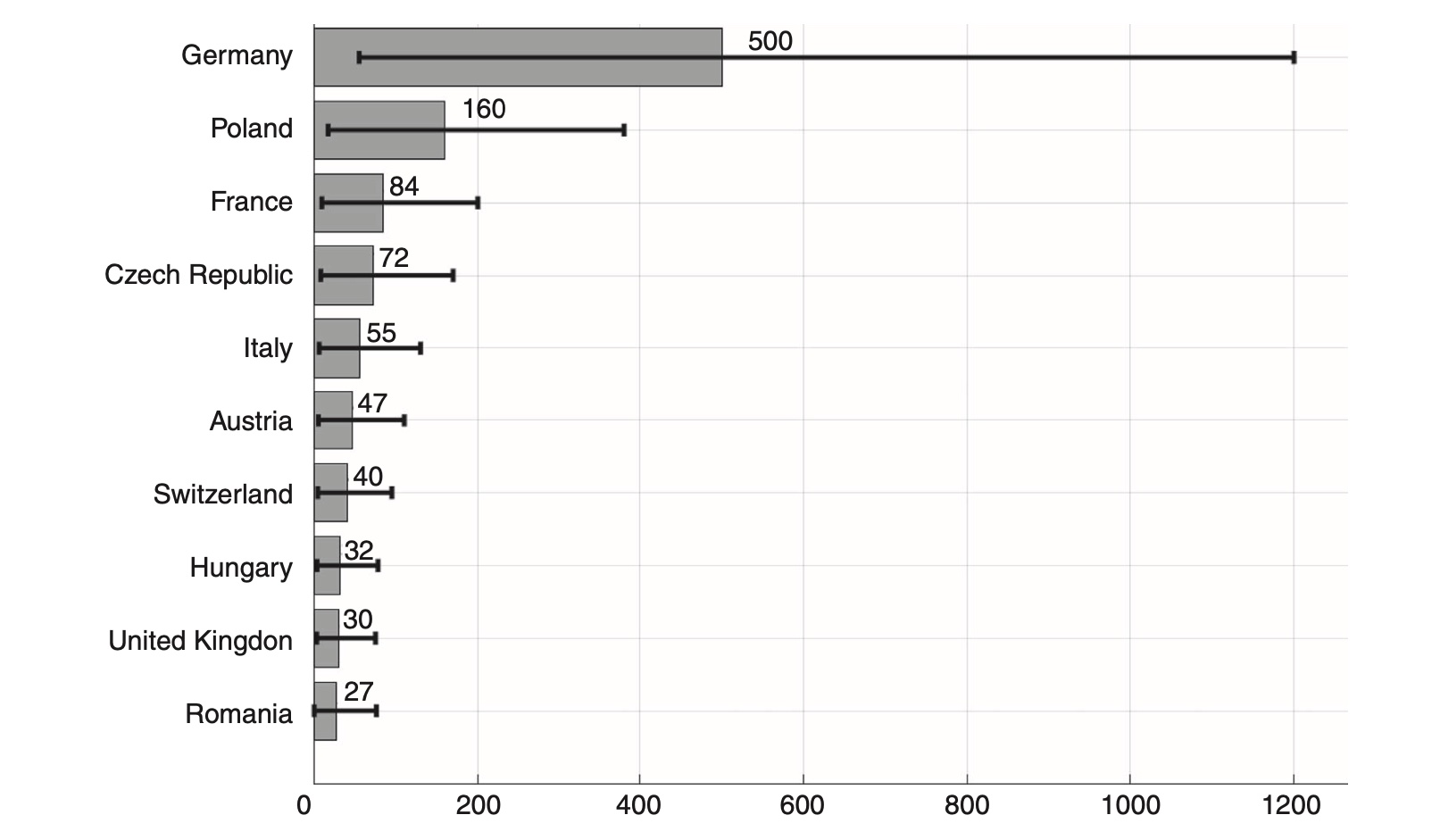
‘1200 premature deaths in Europe, corresponding to 13 000 life-years lost’ (Chossière et al., 2017)
‘... one of the biggest and boldest frauds in corporate history. The decision by VW, a pillar of Germany’s car industry, to fit “defeat devices” and cheat emissions tests in up to 11m cars has so far cost the company $21bn in fines and compensation in North America alone.’ (https://www.economist.com/books-and-arts/2017/06/01/what-really-happened-at-vw)

(Chossière et al., 2017)

significance vs effect size

insert-transcript#3c77e3c9-1c9d-4036-b65c-13923e12bea9-here

To what extent does being a climate sceptic make you less likely to support measures to mitigate climate change?

insert-transcript#a6d6a8bc-4e95-4755-9fb1-a6cbd0c2fe30-here
There are effects, but they are small-to-medium only. (Remember this is people who *do* vs people who *do not* believe in anthropogenic climate change.)
Figure caption: ‘Correlations between climate change belief and outcome variables. Error bars represent 95% confidence intervals.’
I did look but I do not fully understand the methods. I think the key point here is that we are asking whether, when there is a difference in climate scepticism, there is a corresponding difference in support for various policies.
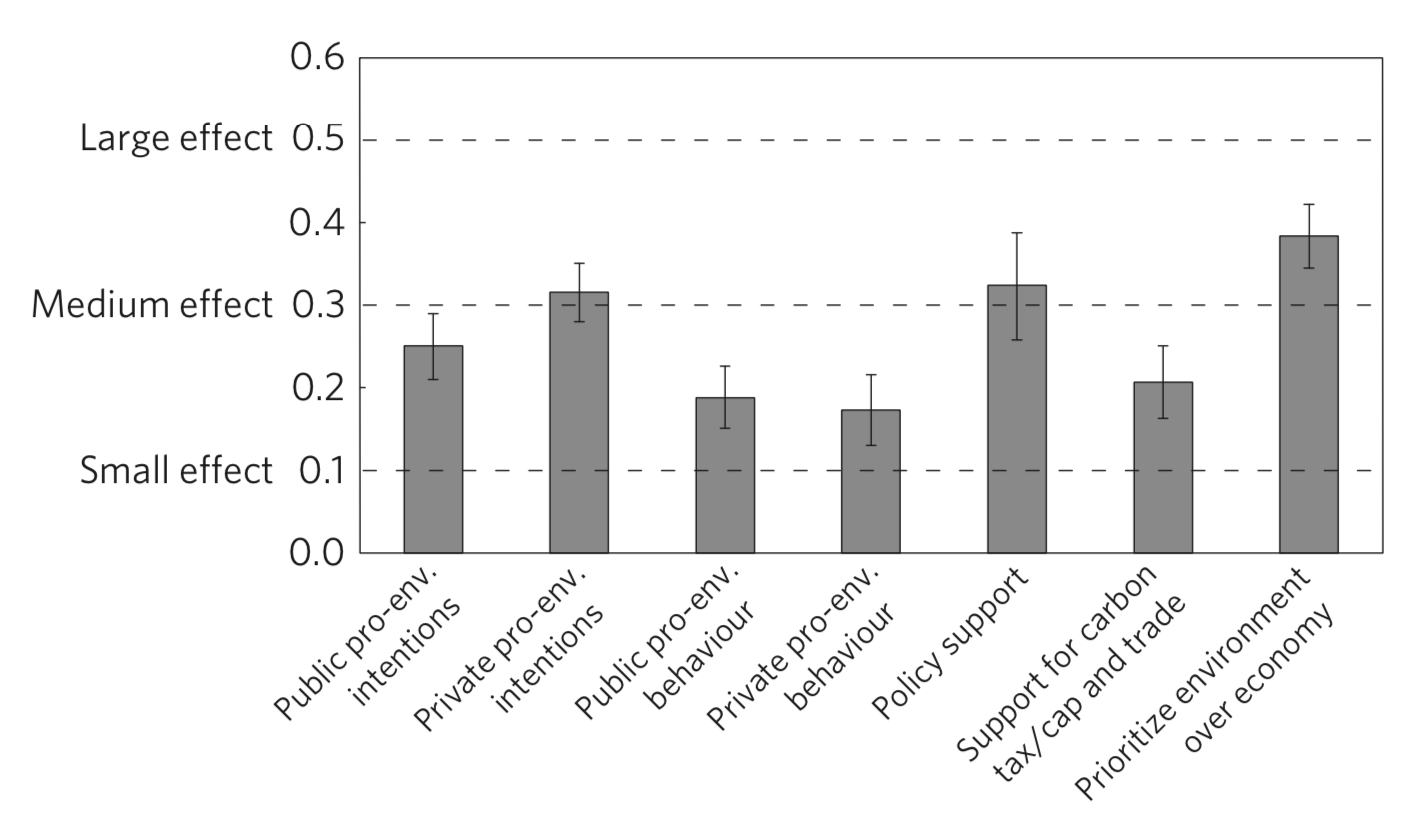
Hornsey, Harris, Bain, & Fielding (2016, p. figure 3)

A key theme in this paper is that belief in climate change makes people much more likely to say they will act but not very much more likely to actually act.
‘When people’s environmental attitudes are measured in abstract ways, the gap between believers and skeptics is considerable: for example, the more people believe in climate change, the more they endorse the notion that the environment should be prioritized over the economy (r = .38). However, when people are asked about a specific proenvironmental policy, the gap between believers and skeptics shrinks. For example, the difference between believers and skeptics in terms of their willingness to put a price on carbon is relatively small (r = .20). A similar narrowing occurs when one compares intentions and behaviors: believers are more likely than skeptics to report that they intend to behave in climate-friendly ways (r = .32) but on actual behaviors the difference is modest (r = .17)’ (p. 21)
insert-transcript#d40b2c8b-a9f6-4588-acd0-067be8a0b8f8-here
attitudes do not matter, moral values do.
(This an oversimplification. It can be used to orient us only.)

‘believers [in climate change] are more likely than skeptics to report that they intend to behave in climate-friendly ways (r = .32) but on actual behaviors the difference is modest (r = .17).’

In other words, knowing whether people are skeptics or believers tells you surprisingly little about their willingness to engage in actions that matter

‘For example, the difference between believers and skeptics in terms of their willingness to put a price on carbon is relatively small (r = .20)’

(Hornsey & Fielding, 2020, p. 21).

insert-transcript#b1272ac0-6b81-489b-978e-69653226d5e7-here

1

Moral convictions and the emotions they evoke shape political attitudes’ and behaviours(Emler, 2003; Mullen & Skitka, 2006; Skitka, Bauman, & Sargis, 2005)’

Feinberg & Willer (2013, p. 1)

steps

1. Nonmoral attitudes (or convictions) do not ...

2. Moral attitudes (or convictions) do ...

am gonna stick with this first step for a moment
insert-transcript#6fc3f2db-20cb-4c7c-b604-ccee743c6381-here
From an old metaanlysis on the relation between attitudes in general and behaviours.
Attitudes generally have relatively little influence on behaviours. How about specifically ethical attitudes?
‘Taken as a whole, these studies suggest that

it is considerably more likely that attitudes will be unrelated or only slightly related to overt behaviors than that attitudes will be closely related to actions’

(Wicker, 1969, p. 65)

‘Only rarely can as much as 10% of the variance in overt behavioral measures be accounted for by attitudinal data.

In studies in which data are dichotomized, substantial proportions of subjects show attitude-behavior discrepancies.

This is true even when subjects scoring at the extremes of attitudinal measures are compared on behavioral indices.’

(Wicker, 1969, p. 65 quoted by Skitka & Bauman, 2008, p. 51).

Wicker (1969, p. 65)

Let’s take one study in this tradition.
insert-transcript#42510b6c-390d-484f-9c56-c1f62e24446e-here

racism and mild torture

(Genthner & Taylor, 1973)

insert-transcript#1c0e3c9b-7e23-4573-9877-b6b0c28dcc1a-here

Participants: 36 males, 18 high/18 low prejudice scores

Measure prejudice and then allow subjects to administer electric shocks to opponents in a game.

Will more prejudiced subjects differentiate between Black and White opponents?

Background: ‘The traditional social learning model posits that a negative attitude [...] facilitates aggression toward a disliked person’

(Genthner & Taylor, 1973, p. 209).

Results: ‘While the low-prejudiced subjects behaved in a relatively nonaggressive manner toward both the Black opponents and the White opponents, the high-prejudiced subjects aggressed equally against’ both

(Genthner & Taylor, 1973, p. 209).

Genthner & Taylor, 1973 p. 209

insert-transcript#deece579-ec59-4151-a196-ad44b5b557f5-here

That research is really old!

What’s the state of the art now

on whether attitudes predict behaviours?

(This is a question for the audience.)
insert-transcript#af7891e2-8ac5-4a88-8eac-339395ed535c-here

1

Moral convictions and the emotions they evoke shape political attitudes’ and behaviours(Emler, 2003; Mullen & Skitka, 2006; Skitka, Bauman, & Sargis, 2005)’

Feinberg & Willer (2013, p. 1)

steps

1. Nonmoral attitudes (or convictions) do not ...

2. Moral attitudes (or convictions) do ...

insert-transcript#a20be2f2-bec9-4ea9-93c6-e38ce9dfc41f-here

[consequences] ‘Overall, how positive or negative do you think the effects of climate change will be on [COUNTRY]?’.

[ethical concern] ‘Some people have moral concerns about climate change. For example, because they think that its harmful impacts are more likely to affect poorer countries, or because they feel a moral responsibility towards future generations. To what extent, if at all, do you have moral concerns about climate change?’
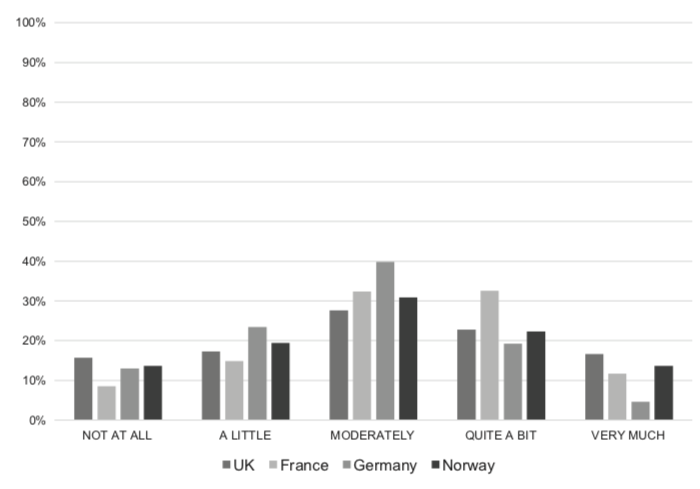
Doran et al, 2019 figure 2

‘Figure 2. Moral concerns about climate change across countries. Percentages of respondents choosing one of the answer options displayed above.’
Key thing to notice is just that there is some variance between countries, which will be important for disentangling effects of ethical concerns.
This was of framing the moral issue will be important later [because it appeals specifically to liberals, according to Feinberg & Willer]

[policies] ‘To what extent do you support or oppose the following policies in [COUNTRY]?’

Doran et al, 2019

Research question (simplified): to what extent will the consequences and ethics influence the policies?
insert-transcript#09a057ac-6d0d-46b8-810e-c728174a972f-here
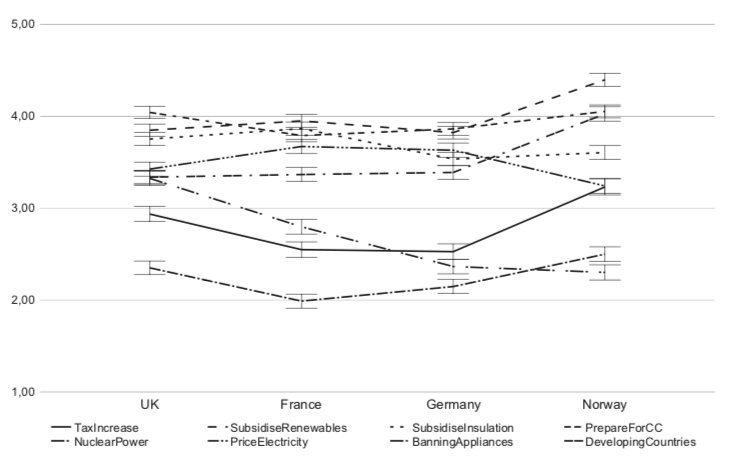
Doran et al. (2019, p. figure 3)

insert-transcript#3165419e-266a-41e6-8ace-ec267b58b3d4-here

Results

‘individuals with strong moral concerns about climate change tend to be more likely to support climate policies.

moral concerns turned out to be substantially more important than consequence evaluations, explaining about twice as much of the variance.’

(Doran et al., 2019, p. 622)

Implication: ‘threat raising campaigns may not be the preferred strategy to encourage public engagement with climate change’

Doran et al. (2019)

insert-transcript#4c146658-f133-4f26-ac0f-528e2b7115d5-here

1

Moral convictions and the emotions they evoke shape political attitudes’ and behaviours(Emler, 2003; Mullen & Skitka, 2006; Skitka, Bauman, & Sargis, 2005)’

Feinberg & Willer (2013, p. 1)

steps

1. Nonmoral attitudes (or convictions) do not ...

2. Moral attitudes (or convictions) do ...

So: I think there is some evidence for this claim, although it is clearly a complex issue and much more could be said. My aim here is this: I hope you now at least understand how researchers have attempted to gather relevant evidence, and have some sense that the claim may be true.
Everything clear? Any questions or objections?