
Keyboard Shortcuts?f

×
  • Next step
  • Previous step
  • Skip this slide
  • Previous slide
  • mShow slide thumbnails
  • tShow transcript (+SHIFT = all transcript)
  • nShow notes (+SHIFT = all notes)

Please be cautious in using the transcripts.

They were created mechanically and have mostly not been checked or revised.

Here is how they were created:

  1. live lecture recorded;
  2. machine transcription of live recording;
  3. ask LLM to clean up transcript, and link to individual slides.

This is an error-prone process.

Click here and press the right key for the next slide.

(This may not work on mobile or ipad. You can try using chrome or firefox, but even that may fail. Sorry.)

also ...

Press the left key to go backwards (or swipe right)

Press n to toggle whether notes are shown (or add '?notes' to the url before the #)

Press m or double tap to slide thumbnails (menu)

Press ? at any time to show the keyboard shortcuts


Moral Psychology Drives Environmental Concern

insert-transcript#68044505-eca0-45c5-9c4e-d6a1991cdcd4-here

The story so far ...

1. ‘Moral convictions and the emotions they evoke shape political attitudes’

2. There are at least two foundational domains of human morality, including harm and purity.

3. ‘liberals and conservatives possess different moral profiles’

insert-transcript#6449592a-a887-47c7-9701-5549fd618896-here

4

‘we hypothesized that liberals express greater levels of environmental concern than do conservatives in part because liberals are more likely to view environmental issues in moral terms’

Feinberg & Willer (2013, p. 2)

insert-transcript#2a579aaa-5918-4eeb-8aa9-69fbe646605f-here
Feinberg & Willer, 2013 figure 1

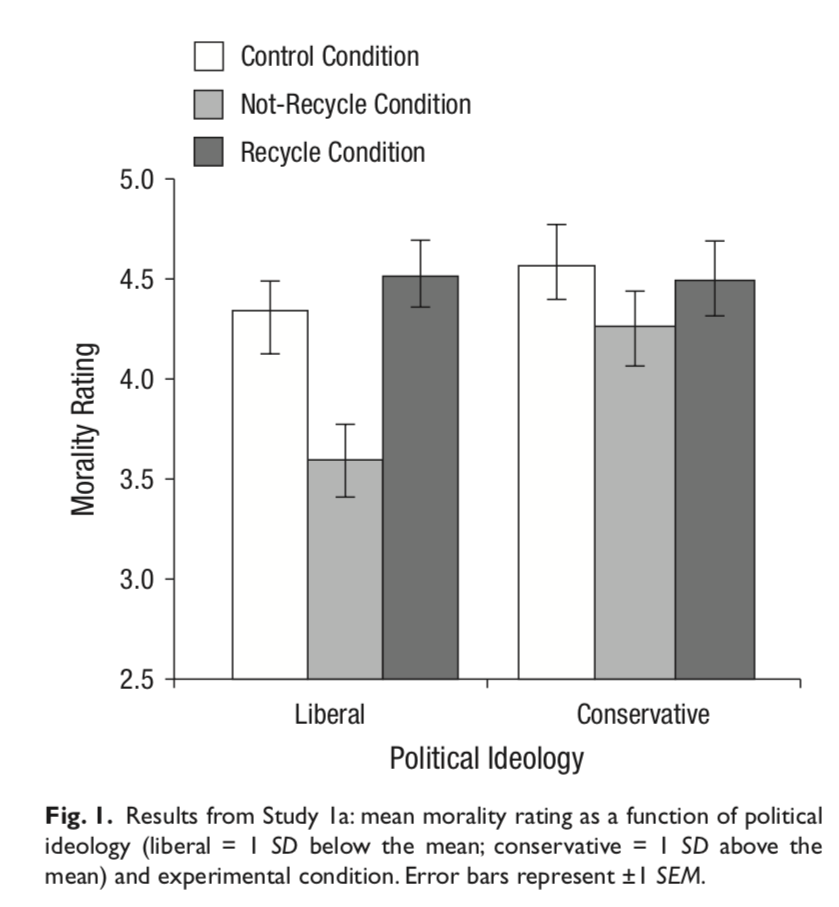
Fig. 1. Results from Study 1a: mean morality rating as a function of political ideology (liberal = 1 SD below the mean; conservative = 1 SD above the mean) and experimental condition. Error bars represent ±1 SEM.
‘The one difference was whether or not, after eating his lunch, the target chose to recycle his plastic water bottle (recycle condition) or throw it away as garbage (not-recycle condition). In the control condition, there was no mention of this bottle. Participants then rated the target on how moral they perceived him to be overall on a scale from 1 (not moral at all) to 6 (extremely moral)’ (Feinberg & Willer, 2013, p. 3).

replication

similiar studies

review

Actually some of what comes later will support this result. But I will leave it as an exercise to you.
insert-transcript#1f823237-fa41-4495-aa16-b0454a242e78-here

4

‘we hypothesized that liberals express greater levels of environmental concern than do conservatives in part because liberals are more likely to view environmental issues in moral terms’

Feinberg & Willer (2013, p. 2)

We have already seen (1) liberals express greater levels of envoromental concern and (2) liberals are more likely to view environmental issues in moral terms
But is there evidence for the ‘because’? (that is, for (2) because (1)?)
How do they justify this claim? I think the argument is indirect.
insert-transcript#b69bad2d-9f2d-4ce2-9649-2601abccc9e0-here
Preacher & Hayes (2008, p. figure 1)

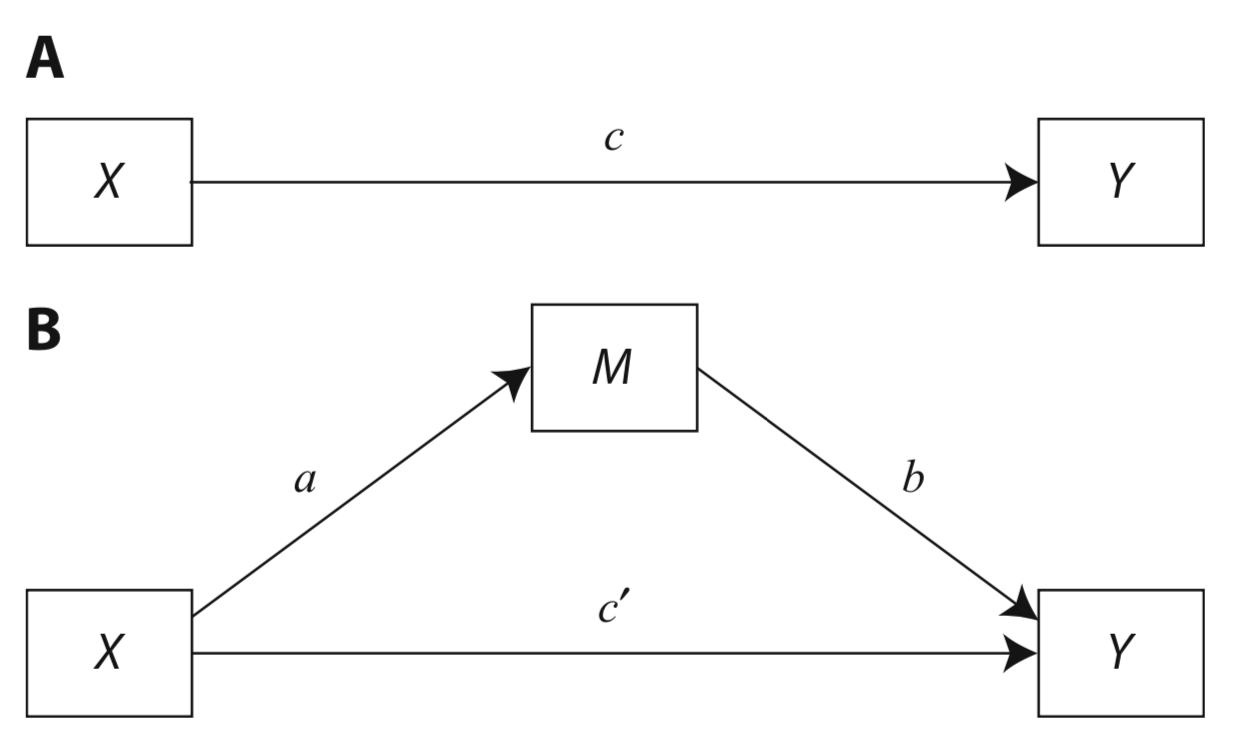
This paper is about how to detect multiple mediators (see figure 2), but we don't need that complexity.

‘A mediation analysis (Preacher & Hayes, 2008) revealed that perception of the environment as a moral issue was a significant partial mediator of the relationship between liberalism and environmental attitudes’ (Feinberg & Willer, 2013, p. 3).

insert-transcript#f0976f34-4639-43d1-bab3-a95c7bdff994-here

4

‘we hypothesized that liberals express greater levels of environmental concern than do conservatives in part because liberals are more likely to view environmental issues in moral terms’

(Feinberg & Willer, 2013, p. 2)

Feinberg & Willer, 2013 p. 2

insert-transcript#89a18845-979b-4fe3-96b5-6fdb44aff7ca-here
Return to overall question and point out that it has now been answered ...
but there is a bonus (which strengthens the case for the answer)

Do cultural differences in moral psychology explain political conflict on climate change? Yes!

Plan:

Work through Feinberg & Willer, 2013 ‘The Moral Roots of Environmental Attitudes’