Keyboard Shortcuts?f

×
  • Next step
  • Previous step
  • Skip this slide
  • Previous slide
  • mShow slide thumbnails
  • tShow transcript (+SHIFT = all transcript)
  • nShow notes (+SHIFT = all notes)

Please be cautious in using the transcripts.

They were created mechanically and have mostly not been checked or revised.

Here is how they were created:

  1. live lecture recorded;
  2. machine transcription of live recording;
  3. ask LLM to clean up transcript, and link to individual slides.

This is an error-prone process.

Click here and press the right key for the next slide.

(This may not work on mobile or ipad. You can try using chrome or firefox, but even that may fail. Sorry.)

also ...

Press the left key to go backwards (or swipe right)

Press n to toggle whether notes are shown (or add '?notes' to the url before the #)

Press m or double tap to slide thumbnails (menu)

Press ? at any time to show the keyboard shortcuts


Does emotion influence moral judgment or merely motivate morally relevant action? (Reprise)

insert-transcript#9a79a16e-4224-468e-b51f-eea3dcd63023-here
Start with the easy one ...

puzzle

Why do feelings of disgust influence moral intuitions?

(And why do we feel disgust in response to moral transgressions?)

puzzle

Why are moral judgements sometimes, but not always, a consequence of reasoning from known principles?

This is what moral disengagement shows (sometimes).
This is what dumbfounding shows (not always).
insert-transcript#6e4b7739-1e62-4c81-94fe-4e69ac1e2c49-here
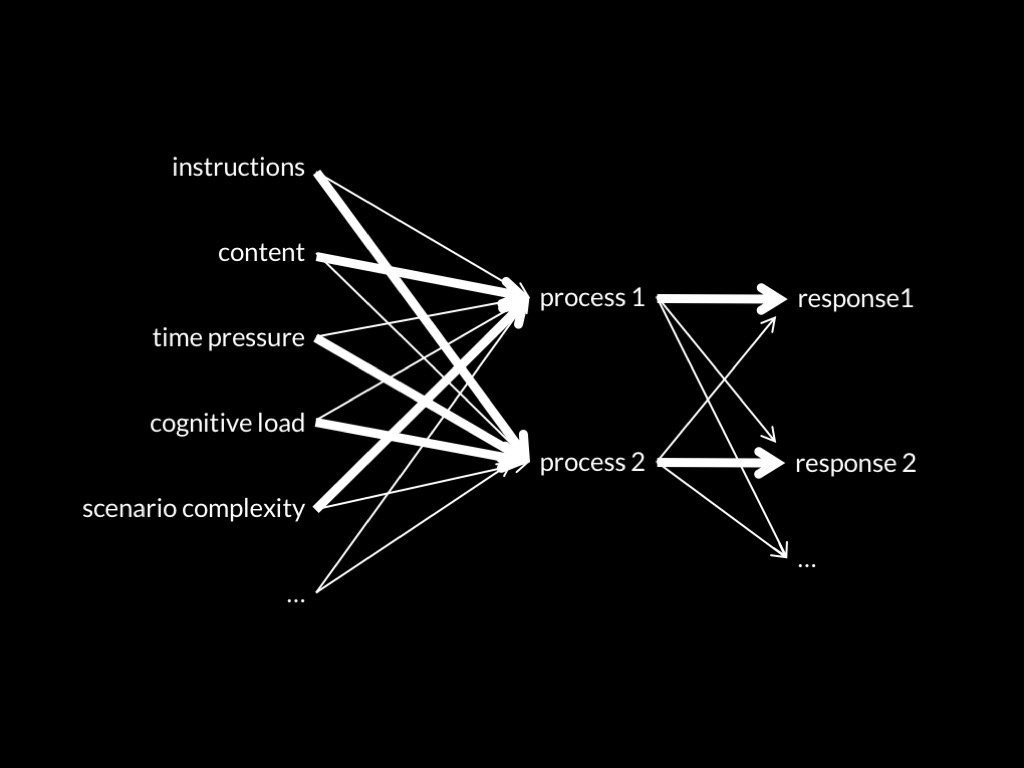
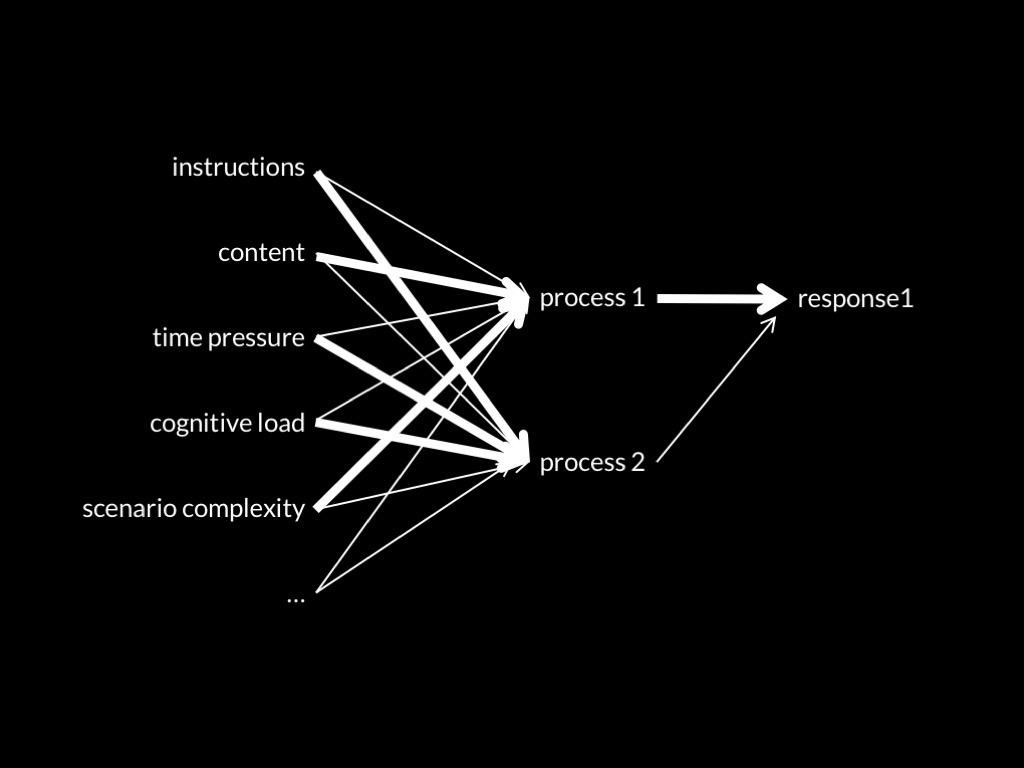
The explanation for why reason does not play a big role is just that the fast process can influence judgements,
and the reason this does not always happen is that sometimes the slow process dominates.
This is not entirely satisfactory. Further questions: how does the fast process influence judgements (via heuristics is my guess)?; and under what conditions can we predict a fast process dominated response (not simply a matter of time pressure *after* reading a dilemma)?
insert-transcript#2998c7ae-2ef4-48b2-841b-d3fdbef01461-here

Dual-process theory of moral judgement helps us in two ways.
First, it resolves reasonsing–emotion puzzle. (We just reviewed this.)
Second, it provides a powerful argument which appears to generate objections to many ethical theories. (We are about to reviewed this.)
Image source: bing-ai

puzzle

Why do feelings of disgust influence moral intuitions?

(And why do we feel disgust in response to moral transgressions?)

puzzle

Why are moral judgements sometimes, but not always, a consequence of reasoning from known principles?

Now for the harder puzzle: Why do feelings of disgust influence moral intuitions? And why do we feel disgust in response to moral transgressions?
insert-transcript#0db27cce-8df9-4581-a0c7-f7c682266d88-here

Does manipulating participants’ feelings influence their moral judgements?

Tracy, Steckler, & Heltzel (2019) : yes

Chapman & Anderson (2013) : yes

Conway & Gawronski (2013, p. study 3) : yes

I didn’t mention this before: In Conway & Gawronski (2013, p. study 3), they manipulated empathy and found an increase in the Deontological Parameter.

But the effects are probably small (Landy & Goodwin, 2015).

insert-transcript#eb8c9d08-e01d-491c-8cda-0d48f77cc273-here

‘we exposed half of the participants in Study 3 to a photograph of the victim who would be harmed in case participants judge harmful action as acceptable.

The rationale for this manipulation was that photographs identify victims, thereby evoking increased empathy and more emotional distress’

(Conway & Gawronski, 2013, p. 226)

prediction: higher empathy will increase the dominance of the less consequentialist process

insert-transcript#4aada246-917a-4430-b1fb-6556e89e1981-here
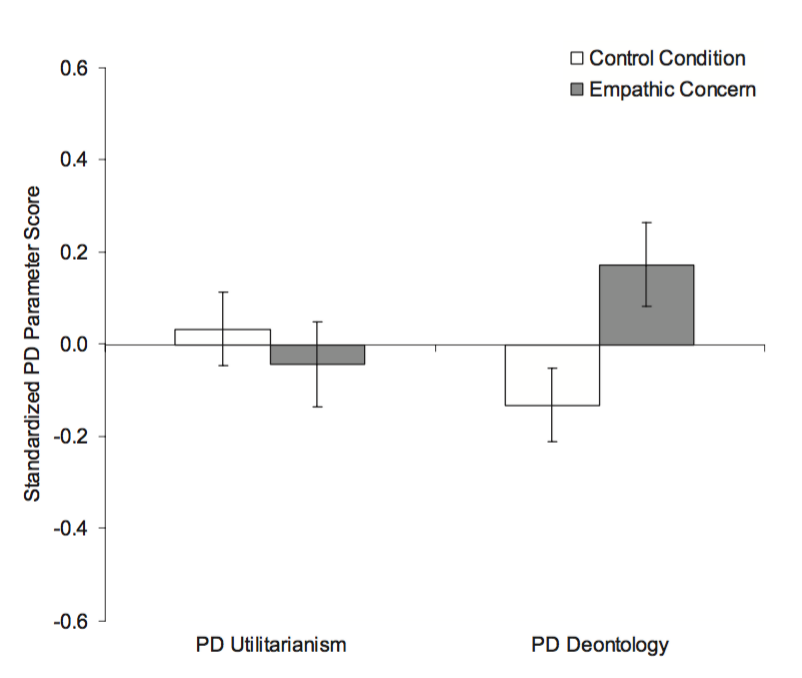
Conway & Gawronski 2013, figure 3

important consequence: if manipulating emotion can selectively influence one of two ethical processes, doesn’t this count as indirect evidence against the causal models on which emotion does not ‘influence’ judgement?
[The idea that manipulating emotion has a selective effect on one process supports the claim that emotion is not affecting (A) scenario analysis, (B) interpretation of question or (C) strength of pre-made judgement. After all, no such hypothesis predicts the selective effect.]
[Also: (Gawronski, Conway, Armstrong, Friesdorf, & Hütter, 2018): ‘(a) sensitivity to consequences, (b) sensitivity to moral norms, or (c) general preference for inaction versus action regardless of consequences and moral norms (or some combination of the three). Our results suggest that incidental happiness influences moral dilemma judgments by reducing sensitivity to moral norms’ (p. 1003).]
Two levels: (1) could do this in principle; (2) let’s see what disgust does to the different factors
insert-transcript#28ad0c0e-a4db-4f92-ad03-4047dda47fa2-here

Does manipulating participants’ feelings influence their moral judgements?

Tracy et al. (2019) : yes

Chapman & Anderson (2013) : yes

Conway & Gawronski (2013, p. study 3) : yes

I didn’t mention this before: In Conway & Gawronski (2013, p. study 3), they manipulated empathy and found an increase in the Deontological Parameter.
insert-transcript#2f6d00fc-5201-4521-97fc-438ddc119cec-here

Further research using process dissociation (CNI):

CNI = Consequences, Norms and Inaction

‘Our results suggest that incidental happiness influences moral dilemma judgments by reducing sensitivity to [deontological] moral norms.’

(Gawronski et al., 2018, p. 1003)

insert-transcript#a4835502-bbac-4df1-bb0a-e444e7069276-here

Does manipulating participants’ feelings influence their moral judgements?

Tracy et al. (2019) : yes

Chapman & Anderson (2013) : yes

Conway & Gawronski (2013, p. study 3) : yes

Gawronski et al. (2018) : yes

I didn’t mention this before: In Conway & Gawronski (2013, p. study 3), they manipulated empathy and found an increase in the Deontological Parameter.
Here I'm talking about feelings generally whereas the puzzle is about disgust specifically.

But the effects are probably small (Landy & Goodwin, 2015).

insert-transcript#92ce2101-ff18-47b0-a63c-1967630ffeb8-here
What’s hard about the puzzle ‘Why do feelings of disgust influence moral intuitions?’ is that we cannot accept any of the sentimentalist ideas (the effect is too small) but also we cannot think of disgust as mere noise.

puzzle

Why do feelings of disgust influence moral intuitions?

(And why do we feel disgust in response to moral transgressions?)

puzzle

Why are moral judgements sometimes, but not always, a consequence of reasoning from known principles?

insert-transcript#dadb2ec4-ae76-4c6e-bc13-69dbeae224be-here

Q: What do adult humans compute that enables their moral intuitions to track moral attributes (such as wrongness)?

Hypothesis:

They rely on the ‘affect heuristic’: ‘if thinking about an act [...] makes you feel bad [...], then judge that it is morally wrong’.

(Sinnott-Armstrong, Young, & Cushman, 2010)

Objection:

The effects of feeling on moral judgement are small (Landy & Goodwin, 2015).

Aside: Evidence for the role of emotion in moral judgement is weak compared to evidence for its role in judgements of risk (e.g. Slovic, Finucane, Peters, & MacGregor, 2007).

insert-transcript#93eb0cda-5b3e-4a5b-b0fa-24df02362190-here

How could emotion influence moral judgement?

comparison 1: bitterness and toxicity judgements

Compare to the dual-process theory of toxicity judgments. Bitterness is a cue to toxicity, triggering a food rejection response, but it's only one process among many. Many bitter things are good, and many toxic things aren't bitter.
It would be crazy to rely solely on a "bitterness heuristic." There is so much more to how humans might come to have intuitions about what to eat and what to avoid.
But, equally, you cannot understand those intuitions unless you understand how they are sometimes influenced by bitterness. This is a mechanism important to our survival, and one that humans share with a wide range of other animals including sea anemonies (Garcia & Hankins, 1975).
NB: you can use visual appearance as well as smell in forming intuitions about toxicity (e.g. colours matter)
I think this is a good point but there is more ...

comparison 2: physical cognition

insert-transcript#a2dcffd7-0fa3-4bf0-ab30-6e1022061668-here
Why was it that people untrained in physics so often predicted a spiral, even though they could not have seen such a thing (because it’s physically impossible)?
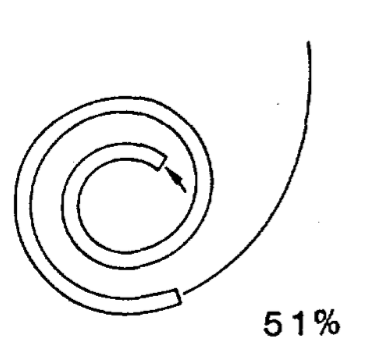
McCloskey, Caramazza, & Green (1980, p. figure 2D)

why?

because fast processes make it appear so
(Kozhevnikov & Hegarty, 2001)

insert-transcript#4add227d-17cb-45ba-b4be-8d4424b35b6f-here

So does the fast process directly influence the slow judgement?

No. (Or not significantly.)

fast process

-> phenomenology of experience

-> imagining seeing

-> thinking about experience

-> (tacit) belief in principles

-> explicit judgement

The fast process provides phenomenal material for slow judgement.

insert-transcript#249ebe12-0851-4b0b-9df9-02cf0f1c5465-here

How is this relevant to moral judgement and emotion?

insert-transcript#2241d7af-7966-4001-8962-42cc88cc9d12-here

Affect Heuristic

‘if thinking about an act [...] makes you feel bad [...], then judge that it is morally wrong’ (Sinnott-Armstrong et al., 2010).

The emotion influences judgement *at the time it is made*.

prediction: manipulating emotion will influence judgement

Dual-Process Theory

fast process

-> feeling (e.g. disgust)

-> thinking about feelings

-> (tacit) belief in principles

-> explicit judgement

The fast process provides emotional material for slow judgement.

prediction: some moral violations will evoke emotions (e.g. disgust)

[Why does the prediction follow?!]
insert-transcript#33d9e939-97e0-4d74-8909-6fc44dc4fdfa-here

comparison 1: bitterness and toxicity intuitions

disgust is just one of several faster processes

comparison 2: physical cognition

disgust’s effects on intuitions may be indirect and asynchronous

insert-transcript#530a6141-0e5a-4f30-99a1-dbb14a4f7320-here

puzzle

Why do feelings of disgust influence moral intuitions?

(And why do we feel disgust in response to moral transgressions?)

puzzle

Why are moral judgements sometimes, but not always, a consequence of reasoning from known principles?