Keyboard Shortcuts?f

×
  • Next step
  • Previous step
  • Skip this slide
  • Previous slide
  • mShow slide thumbnails
  • tShow transcript (+SHIFT = all transcript)
  • nShow notes (+SHIFT = all notes)

Please be cautious in using the transcripts.

They were created mechanically and have mostly not been checked or revised.

Here is how they were created:

  1. live lecture recorded;
  2. machine transcription of live recording;
  3. ask LLM to clean up transcript, and link to individual slides.

This is an error-prone process.

Click here and press the right key for the next slide.

(This may not work on mobile or ipad. You can try using chrome or firefox, but even that may fail. Sorry.)

also ...

Press the left key to go backwards (or swipe right)

Press n to toggle whether notes are shown (or add '?notes' to the url before the #)

Press m or double tap to slide thumbnails (menu)

Press ? at any time to show the keyboard shortcuts


Conflicting Evidence against a Dual-Process Theory of Moral Judgement

insert-transcript#8475311e-150b-4888-a6a7-b74877267122-here

Dual Process Theory of Ethical Abilities (core part)

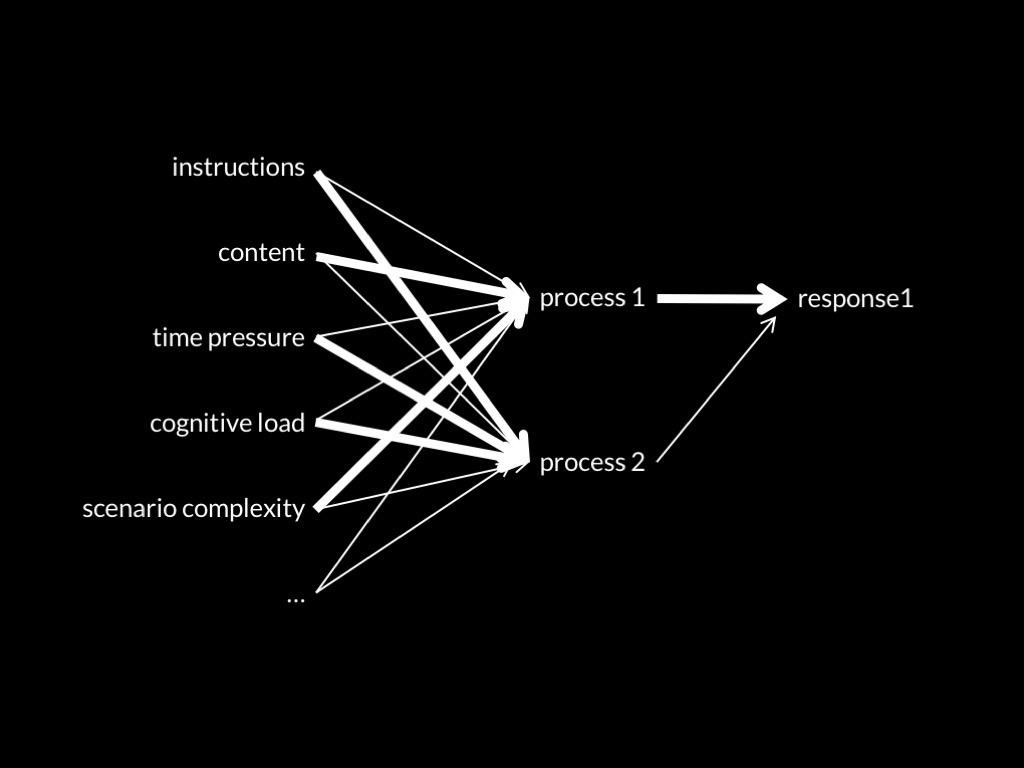
Two (or more) ethical processes are distinct:
the conditions which influence whether they occur,
and which outputs they generate,
do not completely overlap.

One process makes fewer demands on scarce cognitive resources than the other.

(Terminology: fast vs slow)

aux. hypothesis: The slow process is responsible for characteristically consequentialist responses; the fast for other responses.

evidence against the auxiliary hypothesis
insert-transcript#ac1d6057-fec0-40dc-8161-47e9a6fd08c2-here

aux. hypothesis: The slow process is responsible for characteristically consequentialist responses; the fast for other responses.

Suter & Hertwig, 2011 : yes

Bago & de Neys, 2019 : no

another study: conflicting evidence
insert-transcript#9b991c4a-b5fd-4e69-a6f5-04c51dbb313c-here

‘Submarine (4/60)

You are responsible for the mission of a submarine [...] leading [...] from a control center on the beach. An onboard explosion has [...] collapsed the only access corridor between the upper and lower levels of the ship. [...] water is quickly approaching to the upper level of the ship. If nothing is done, 12 [extreme:60] people in the upper level will be killed.

[...] the only way to save these people is to hit a switch in which case the path of the water to the upper level will be blocked and it will enter the lower level of the submarine instead.

However, you realize that your brother and 3 other people are trapped in the lower level. If you hit the switch, your brother along with the 3 other people in the lower level (who otherwise would survive) will die [...]

Would you hit the switch?’

(Bago & De Neys, 2019, p. supplementary materials)

Bago & de Neys, 2019 supplementary materials

there's also an impersonal case where it's not your brother
insert-transcript#9443a8ab-f79f-4504-9142-fbbe437b4ec2-here

first response under time pressure and cognitive load

second response under neither

aux. hypothesis: The slow process is responsible for characteristically consequentialist responses; the fast for other responses.

let's think about what our predictions might be

prediction: first response will be less influenced by outcomes than the second

What can we predict?
Because they did not vary the outcomes, this is tricky. (Save for later.)
the prediction would be that the first response will not take into account the live saved in the same way that the second response will (because you think of switching the water as more immediately killing)
insert-transcript#70d6b1ad-f787-42c4-b148-60fc3bef75a6-here
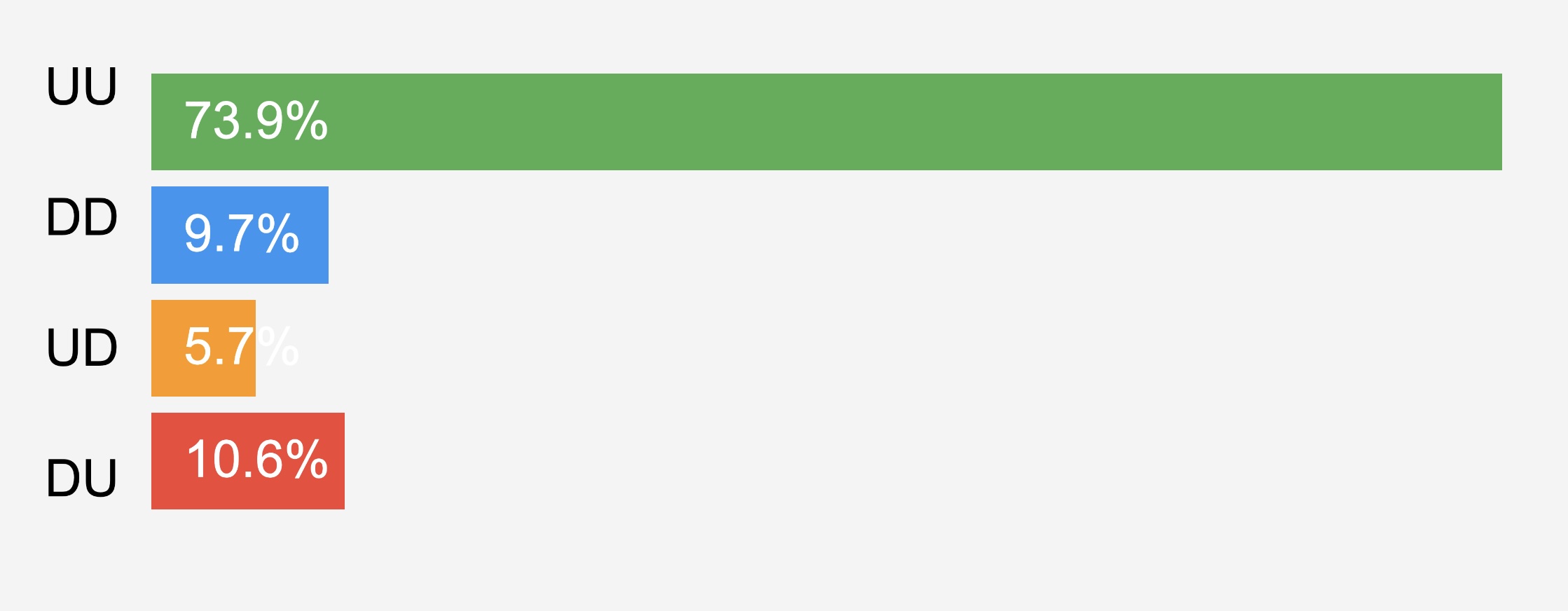
These are the results from Study 1, drawn from table 1
UU = first decision was utilitarian, so was second
UD = first decision was utilitarian, second was deontological
Could it be just that everyone is utilitarian in this study? Or maybe we should take comfort from the fact that more people were DU than UD? No because ....
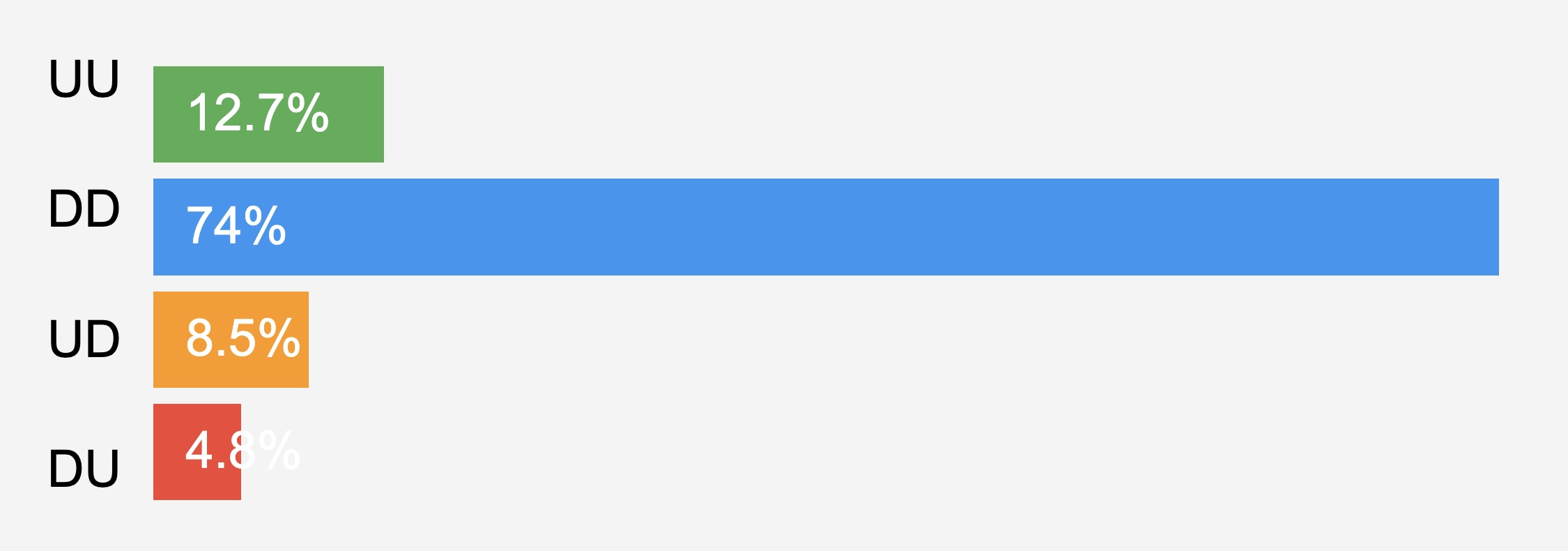
These are the results from Study 2, drawn from table 1

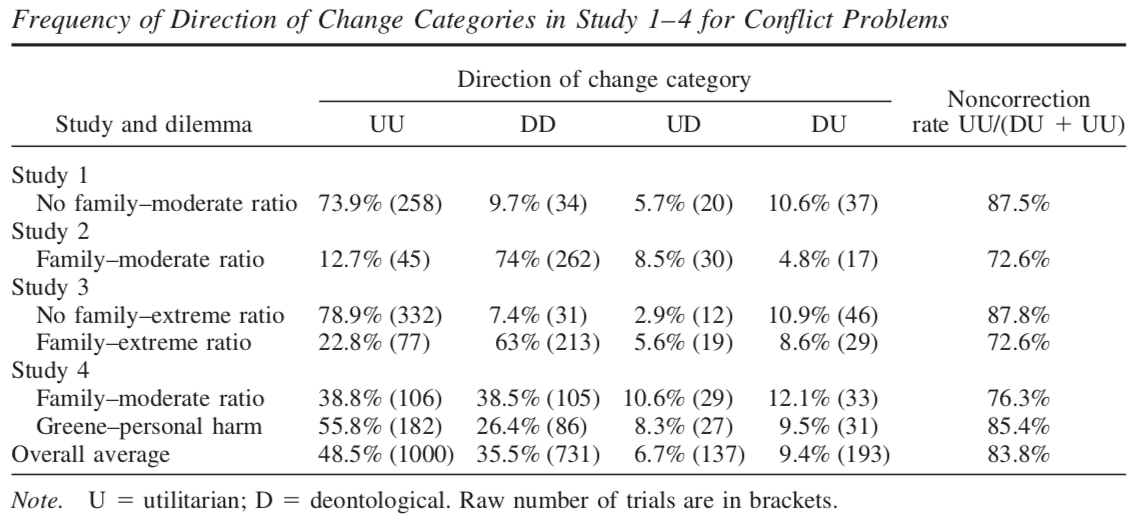
drawn from Bago & De Neys (2019, p. table 1)
insert-transcript#77271524-9d25-41f7-8241-dd37199b1c56-here
First response vs second response.

Bago & de Neys, 2019 table 2

so first of all how many people are giving what they're calling a utilitarian response to both first and second time they're asked
now how many people are doing the opposite so they're consistently not pressing the switch both responses
now this is the pattern we're not expecting so what's happening here is that people are under time pressure and cognitive load saying gosh you know what i'm going to save the large number of people but then switching and saying actually i'm not going to press the switch after all now that's exactly the opposite of what we'd expect
Study 1: lots of consequentialist responses (= U)
Finally, here's what we might be expecting if the auxiliary hypothesis is true these people who first of all are saying that i'm not going to press the switch and then they're like oh actually i've got a bit more time on reflection probably going to save more people sorry about the folks in the lower deck and that's about 11%
Can also compute ‘noncorrection’ rate for those responses whihc ended D (ie. DD/(UD+DD)). In this study it’s 63% I.e. proportion of switchers *to* D was higher than proportion of switchers to U!
Study 2: few consequentialist responses (= U) But still reversals are few.
Can also compute ‘noncorrection’ rate for those responses whihc ended D (ie. DD/(UD+DD)). Overall for all studies it’s 84.2% I.e. proportion of switchers *to* D was only 0.4% lower than to U!
insert-transcript#958f1328-f247-48f9-a44f-01b99bf6e4b1-here

‘Our critical finding is that although there were some instances in which deliberate correction occurred, these were the exception rather than the rule.

Across the studies, results consistently showed that in the vast majority of cases in which people opt for a [consequentialist] response after deliberation, the [consequentialist] response is already given in the initial phase’

(Bago & De Neys, 2019, p. 1794).

Bago & de Neys, 2019 p. 1794

Objection 1: consistency effects? No!

they consider this response and they note this in a pilot study they found that in one of the dilemmas they got roughly speaking 85 percent who when asked just once were giving a consequentialist response
so they're asked once they give a consequentialist response in the main study when people ask twice they find the same 84 roughly percent giving the consequentialist response right away
so it looks like if we were looking for consistency effects here we would expect that the proportion of people giving a consequentialist response would change when they were asked the question twice versus when they were just asked asked it once but it doesn't seem to have an effect there
‘a potential consistency confound in the two-response paradigm. That is, when people are asked to give two consecutive responses, they might be influenced by a desire to look consistent [...] However, in our one-response pretest we observed 85.4% [...] of [consequentialist] responses on the conflict versions. This is virtually identical to the final [consequentialist] response rate of 84.5% [...] in our main two-response study (see main results).’

Objection 2: No influence of fast process?

Note that the dilemma is quite lengthy. People have to read and understand the dilemma before they can finally decide. But it is possible that, in reading and understanding it, they are also already making up their minds. In that case, there is no effect of time pressure because people have plenty of time to decide their response in advance. This would explain why few participants change their responses at all.
I belive this is a good objection, but there is a problem ...
The problem is that Suter & Hertwig, 2011 claim to find an effect of time pressure with a similar design! So if we make this objection to Bago & de Neys, 2019, then the evidence of Suter & Hertwig, 2011 appears to contradict it.
(This is a tricky argument because of course if we accept Bago & de Neys, 2019 then we have contradicted Suter & Hertwig, 2011 anyway. Still, we can use the premise that Suter & Hertwig, 2011 is correct as a kind of reductio for this objection.)
insert-transcript#d434bd89-5bb9-4ebd-8ab8-6f0c13bbf178-here

aux. hypothesis: only the slow process flexibly takes into account differences in the outcomes of an action

Suter & Hertwig, 2011 : yes

Bago & de Neys, 2019 : no

Check you understand. Thoughts about a possible resolution?

Rosas & Aguilar-Pardo (2020): converse
(more time pressure -> more consequentialist)

Rosas & Aguilar-Pardo (2020)

Vega et al. (2021): opposite patterns in their Studies 1 vs 2

Vega, Mata, Ferreira, & Vaz (2021) found faster responses linked to deontological responses in their Study 1 and the opposite pattern in their Study 2, where both studies use the same paradigm (one of the goals of Study 2 was to replicate the results of Study 1; p. 131).
insert-transcript#d9b30aaf-aa20-4db6-9440-eb6aa2f46d59-here

Dual Process Theory of Ethical Abilities (core part)

Two (or more) ethical processes are distinct:
the conditions which influence whether they occur,
and which outputs they generate,
do not completely overlap.

One process makes fewer demands on scarce cognitive resources than the other.

(Terminology: fast vs slow)

aux. hypothesis: The slow process is responsible for characteristically consequentialist responses; the fast for other responses.

insert-transcript#9a6927fa-2ce6-49e0-8157-53cc12626ca4-here

How to evaluate a theory

1. Never trust a philosopher.

2. How good is the evidence?

a. Has the theory featured in a review? If so, does the review broadly support the theory’s main claims?

b. Is there a variety of studies, from different labs, using different methods, which support the theory’s various predictions?

c. Are there studies which falsify the theory’s predictions?

Just one of many studies, and one of several predictions. So we made good progress but our work is not finished yet.
insert-transcript#16a83f31-fe87-4550-b802-1fa59fa66bf7-here

Evidence Greene (2014) cites includes:

  • Suter & Hertwig (2011)
  • Trémolière & Bonnefon (2014)
  • Conway & Gawronski (2013)
insert-transcript#d39c8c9f-d9ab-4412-ae45-1327b2070595-here

aux. hypothesis: The slow process is responsible for characteristically consequentialist responses; the fast for other responses.

Prediction 1: Limiting the time available to make a decision will reduce consequentialist responses.
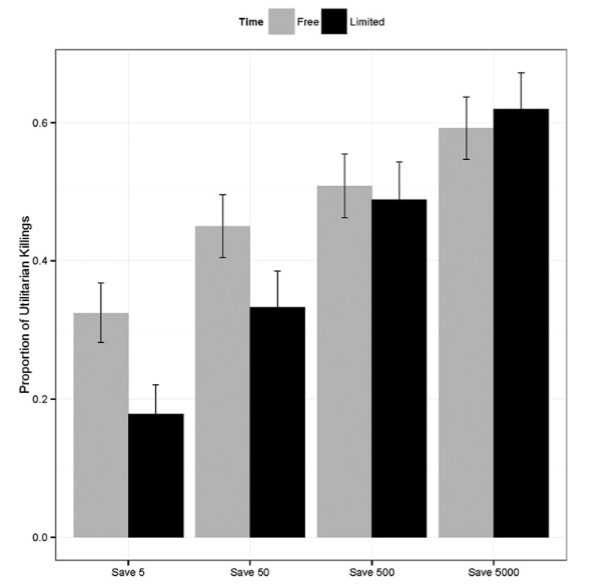
Prediction 2*: Limiting the time available to make a decision will reduce sensitivity to outcomes.

‘the dual-process theory [...] makes the empirical claim that ordinary people’s utilitarian judgments are typically the products of deliberate, aggregate cost-benefit reasoning (Greene et al., 2001, 2004, 2013). Consistent with this claim, people’s judgments are sensitive to aggregate consequences: People who endorse killing one to save five typically do not endorse killing five to save one, or killing one to save zero’ (Conway, Goldstein-Greenwood, Polacek, & Greene, 2018, p. 243).
insert-transcript#88cd4d8c-2803-4ad0-8851-1238ba17f301-here
time pressure study

Trémolière & Bonnefon (2014, p. figure 4)
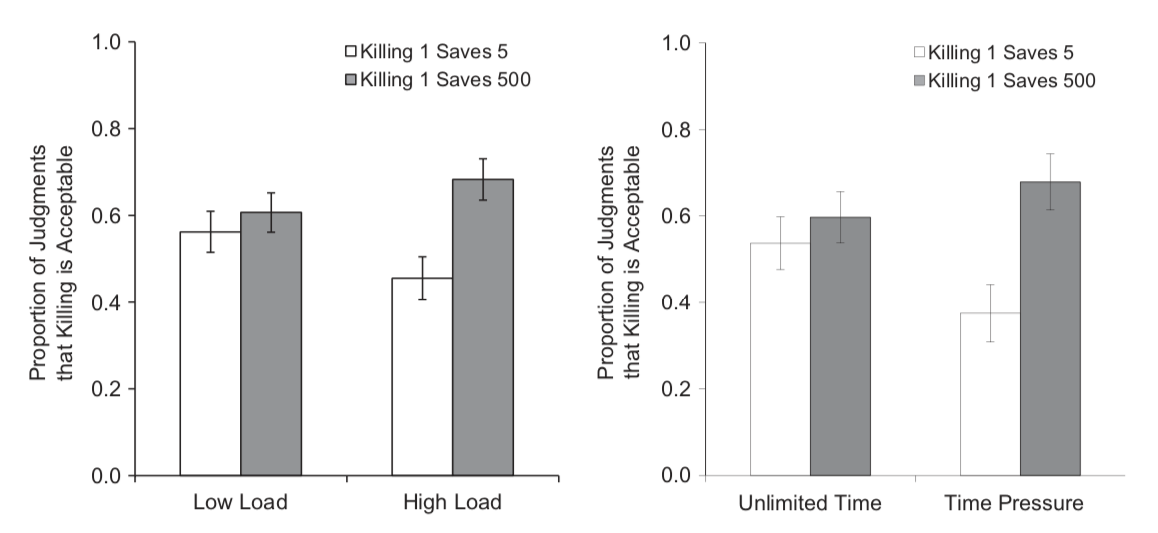
You can see this more clearly by looking at a different graph of the same data ...

Prediction 2*: Limiting the time available to make a decision will reduce sensitivity to outcomes.
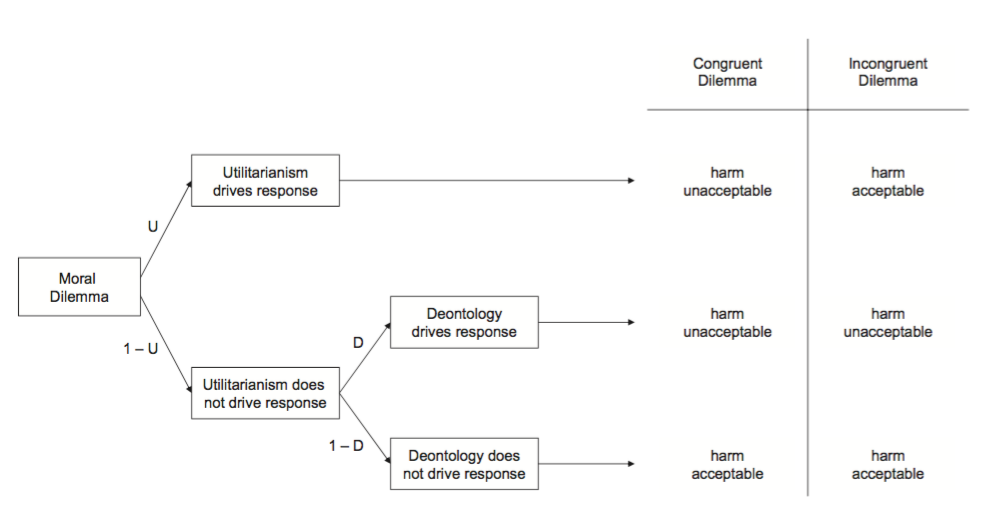
insert-transcript#385ffe3b-55b1-4c14-a960-dd46d79a2578-here

Gawronski & Beer (2017, p. figure 1); data from Trémolière & Bonnefon (2014)

Prediction 2*: Limiting the time available to make a decision will reduce sensitivity to outcomes.

Critique is consistent with Trémolière & Bonnefon (2014)’s own report; but not Greene (2014)’s use of the evidence.
Please be sure you understand
insert-transcript#1aed6607-4b6a-430e-b422-747594a6fdd2-here

Evidence Greene (2014) cites includes:

  • Suter & Hertwig (2011)
  • Trémolière & Bonnefon (2014)
  • Conway & Gawronski (2013)
Saw this last time.
insert-transcript#6e2a6edd-6718-403d-b4b3-f54a78946022-here

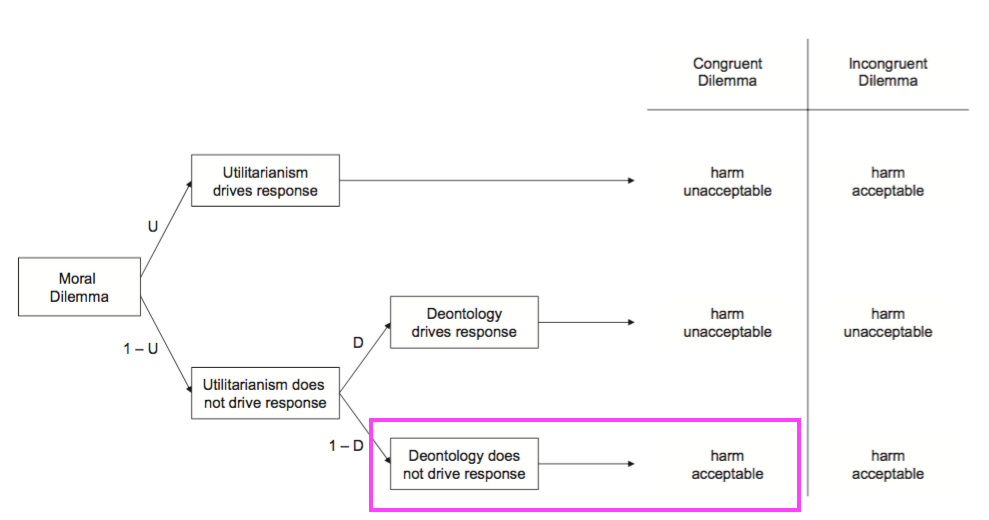
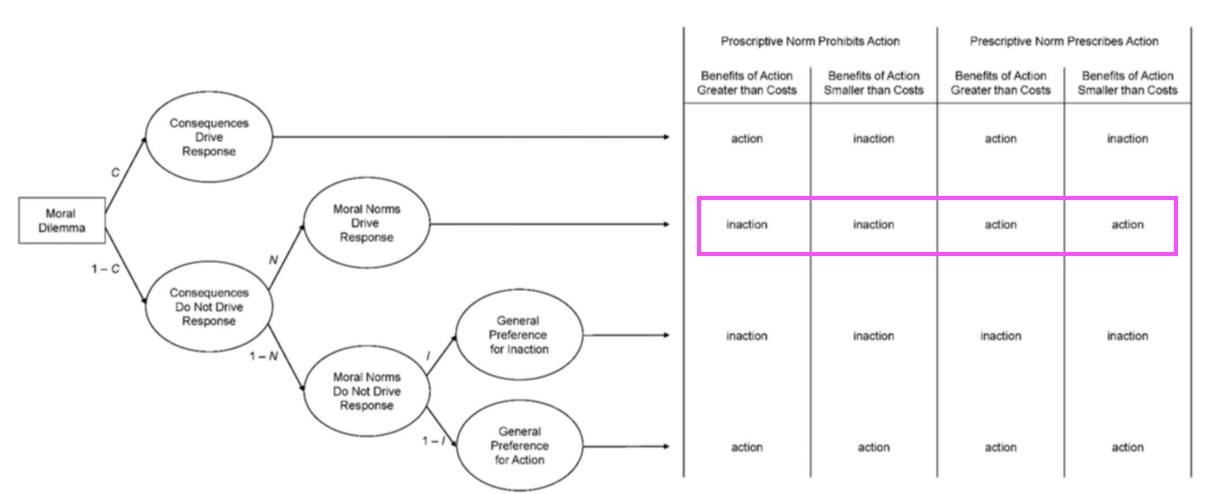
Conway & Gawronsky 2013, figure 1

if you don't give a utilitarian response it doesn't follow automatically that you're going to give a rule-based or deontological response
this is the brilliant thing about them (that bago and denise for some reason are missing they don't seem to take this on board)
it may also be that you give a response might be neither utilitarianism nor dentological
but look at how they conceptualized this neither utilitarian nor deontologial response.
Note that if we just provide ‘incongruent’ dilemmas, we cannot distinguish all the different possibilities.
This is why varying the outcomes (which we do between congruent and incongruent dilemmas) is so important.
conway and goronski conceptualized neither being a consequentialist nor deontologist as basically just harming in every case
‘incongruent dilemma’ : kill one to save five lives (consequentialism says yes, deontology says no)
‘congruent dilemma’ : kill one to prevent a paint bomb from going off (consequentialism and deontology both say no)
insert-transcript#c8a77570-75d2-49c3-842b-75a6e67383fa-here

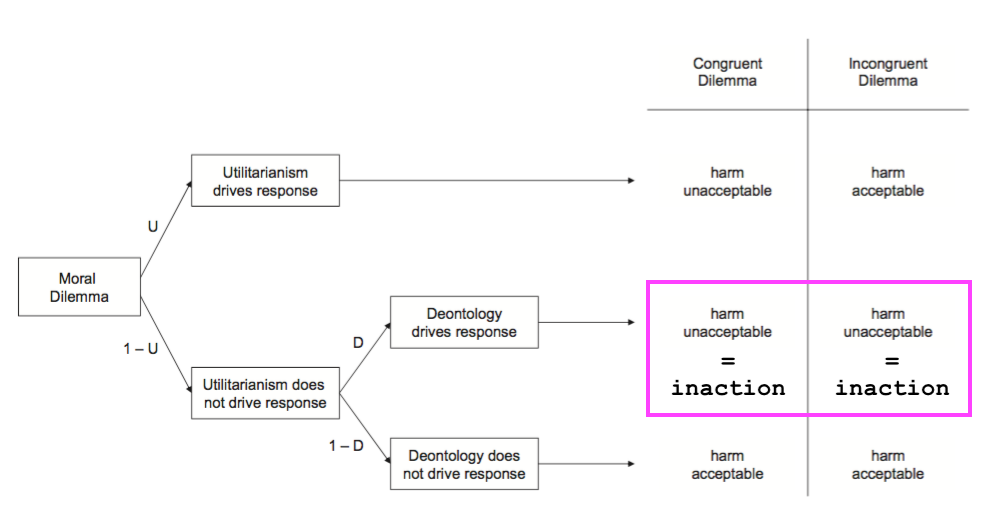
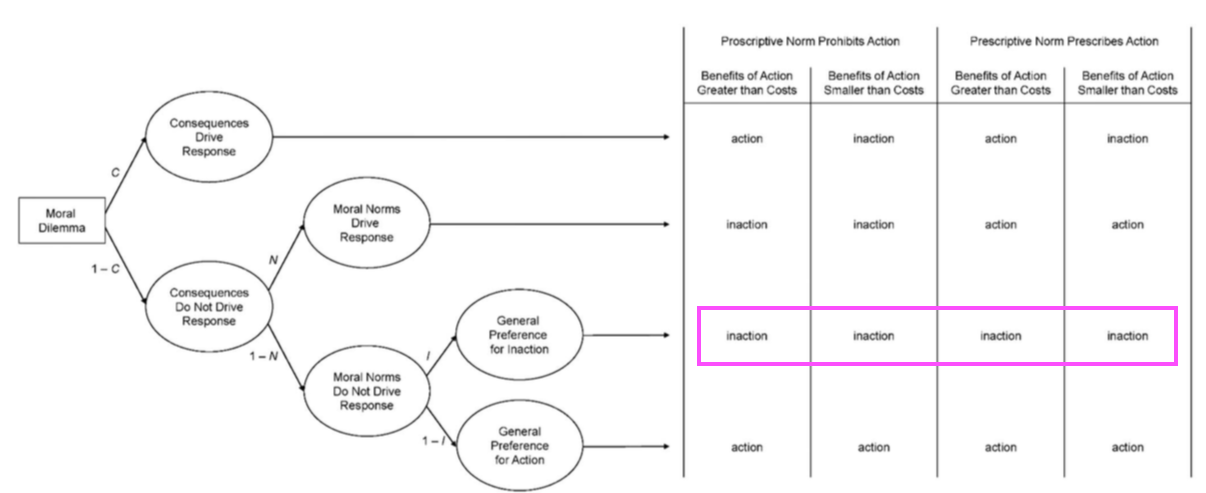
Maybe people just prefer not to act when under time pressure?

here's a reasonable thought: it's not that i'm just going to harm people regardless right it might be that i'm neither going to be utilitarian nor al because the right thing to do if i'm under a lot of time pressure and the stakes are high is simply to hold back and don't act
insert-transcript#530949c9-ffe1-41f2-9a97-4e64ed04533f-here

Conway & Gawronsky 2013, figure 1

insert-transcript#b2b5c25e-e282-40eb-a47a-ac7d4de02658-here

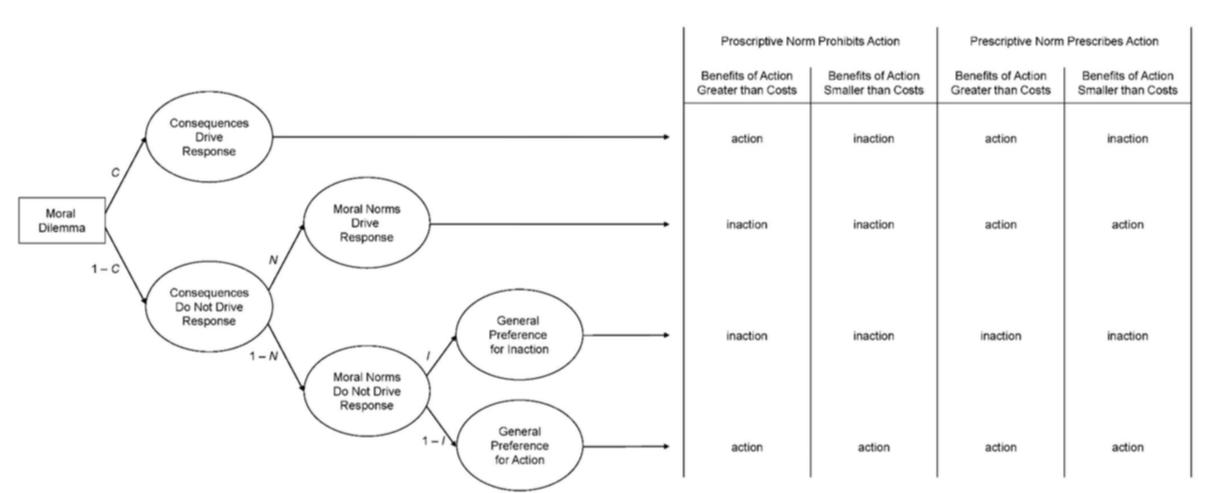
Gawronski et al, 2017 figure 1

They call this new model the CNI (consequences norms and inaction) model
Note that adding a possibility causes a doubling in the number of dilemmas you need. Process dissciation is hard because dilemmas grow exponentially as you add factors.
insert-transcript#31229010-92f6-4a51-a273-634e5ab46dfc-here

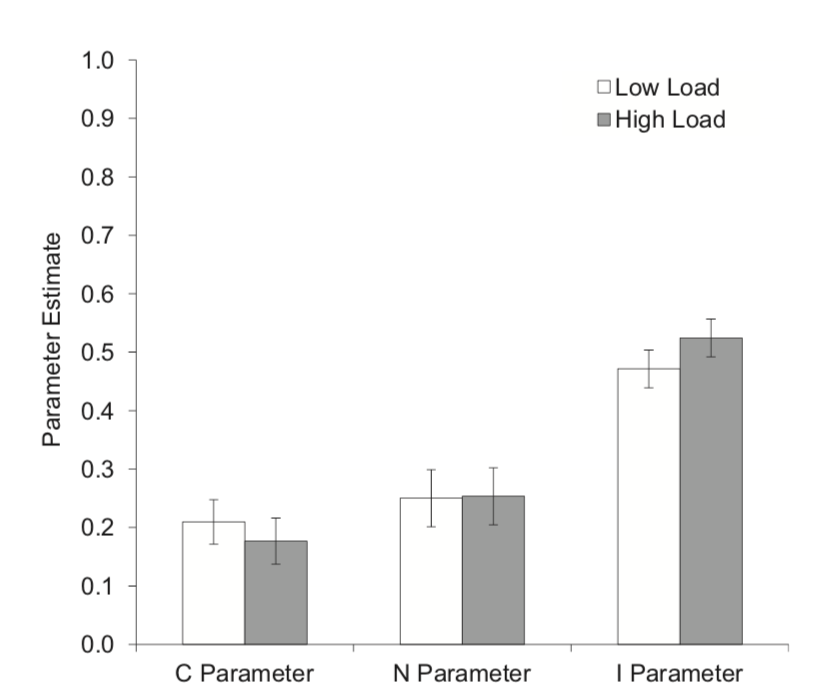
Gawronski et al, 2017 figure 4

What goronski and colleagues did was indeed just that so they tested the sensitivity to consequences ('C parameter') sensitivity norms ('N parameter') and tendency to be inactive ('I parameter')
changing the load with the more advanced model gave us a different result from conway and goronsky what they found essentially was that low versus high low did not change sensitivity to consequences significantly did not and you can see if anything it's going the wrong direction here oops no sorry it's going in the right direction but there's no significant difference it did not change sensitivity to norms at all that's also what conway and goronsky found no surprises there the significance difference was only people's tendency to inaction
so what goronski and colleagues found is that the difference between that low load and the high load seems to be explained by this idea that when you're under high load you prefer not to act at all they put it like this the only significant effect in these studies was a significant increase in participants general preference for inaction as a result of they said did not affect participants sensitivity to morally relevant consequences
insert-transcript#bd6d0c27-cc9f-47f2-99e5-795c082736d6-here

‘The only significant effect in these studies was a significant increase in participants’ general preference for inaction as a result of cognitive load. Cognitive load did not affect participants’ sensitivity to morally relevant consequences’

(Gawronski, Armstrong, Conway, Friesdorf, & Hütter, 2017, p. 363).

‘cognitive load influences moral dilemma judgments by enhancing the omission bias, not by reducing sensitivity to consequences in a utilitarian sense’

(Gawronski et al., 2017, p. 363).

‘Instead of reducing participants’ sensitivity to consequences in a utilitarian sense, cognitive load increased participants’ general preference for inaction. ’

(Gawronski et al., 2017, p. 365).

Gawronski et al, 2017 p. 363

insert-transcript#b5ce5160-84c4-4b8f-a391-2cc23262ffdc-here

Evidence Greene (2014) cites includes:

  • Suter & Hertwig (2011)
  • Trémolière & Bonnefon (2014)
  • Conway & Gawronski (2013)
So for each of these three supporting studies, I suggested that either we have evidence that seems incompatible with their findings or else there are multiple ways of interepreting the findings where not all support the claim Greene aims to establish
Turning to theoretical considerations we can see that there are also good theoretical reasons to go both ways on this ...

fast is deontological

... because being utilitarian requires computing utility—the value of possible consequences—which demands effort.

fast is utilitarian

... because fast is ancient, and evolutionary pressures favour utilitarian outcomes

(at least for kin, perhaps for also in-group members)

Hrdy (1979)

Kurzban, DeScioli, & Fein (2012)

One indicator of the 'fast is utilitarian' idea comes from research on non-nutritional filial infanticide, which appears to be widespread in animals including humans (see Hrdy (1979, p. 16ff) on ‘Parental Manipulation’).
The idea is that parents are often willing to sacrifice an infant if doing so will disproportionately benefit existing or future siblings.
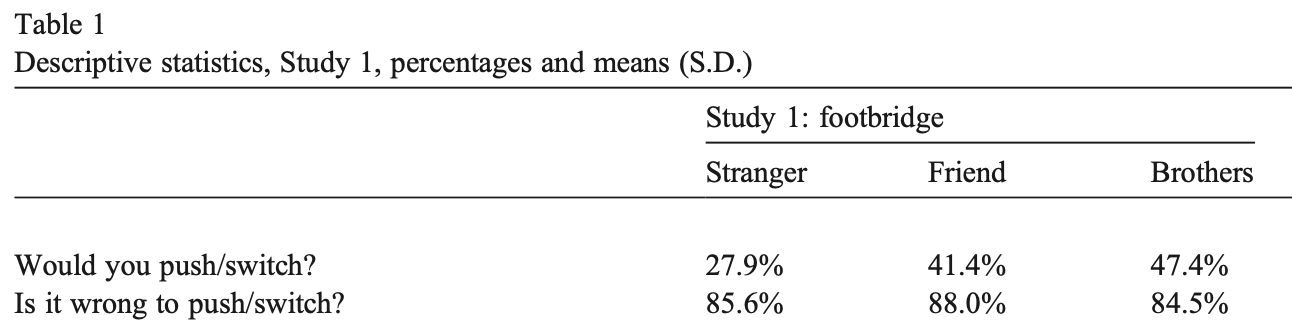
Further inspiration for this might be taken from Kurzban el at’s finding that people are quite willing to sacrifice one Friend or Brother to save five Friends or Brothers.
This is inspired by Kurzban et al. (2012) rather than something those authors endorse.
Kurzban et al. (2012) argue that the greater-willingness-to-kill-a-family-member-to-save-five-family-members effect is due to people showing greater altruism towards kin (and friends) than strangers: they are more willing to risk condemnation by others[^attack] in order to gain aggregate benefits. If this is right, the difference between responses to dilemmas with all kin vs with all strangers might work as a (probably group-level) measure of tribalism.
[^attack]: people avoid breaking moral rules to avoid ‘a coordinated moral attack against themselves’ (p. 333)
More carefully, Kurzban et al. (2012) say the effect arises because: i. there are at least two ‘decision processes’ involved, one that is sensitive to rules like ‘do not kill’ and one that just seeks ‘to maximize utility’ with no prohibitions; ii. it is costly for people to break the moral rules---doing so risks ‘a coordinated moral attack against themselves’ (p. 333); iii. it is altruistic to ignore the rules to obtain the best aggregate outcome; iv. people are more altruistic towards kin than strangers.
[Interesting case to think through as a potential contrast to ethical decoupling: because the different questions (would you ...? vs is it wrong to ...?) bring out different answers. there appear to be multiple, conflicting attitudes to pushing a Brother in the footbridge case. The ‘Is it wrong?’ question might be prompting people to think about laws, about what others will say, or about their own feelings of guilt.]
insert-transcript#c4f23c98-8707-4dc4-9360-bd56e7296864-here

How to evaluate a theory

1. Never trust a philosopher.

2. How good is the evidence?

a. Has the theory featured in a review? If so, does the review broadly support the theory’s main claims?

b. Is there a variety of studies, from different labs, using different methods, which support the theory’s various predictions?

c. Are there studies which falsify the theory’s predictions?

Oh wait, this is interesting! We seem to have conflicting evidence!
Picture so far was that each study does not stand up to further research. So that’s an indicator. But it’s not quite so simple ...
insert-transcript#6eb086b3-c727-461f-a74f-1f773aa888bf-here

aux. hypothesis: The slow process is responsible for characteristically consequentialist responses; the fast for other responses.

Suter & Hertwig, 2011 : yes

Bago & de Neys, 2019 : no

Gawronski et al, 2017 : no

Can we resolve the apparent contradiction by preference for inaction under time-pressure?

I don’t see how. Both studies used nonconsequentialist = deontological. So any preference for inaction under time-pressure should have had the same effect in both studies!
These studies’ results appear to confict (time-pressure does/doesn't make people less consequentialist)
These studies’ results appear to confict (time-pressure has barely any effect / does make people less consequentialist [because prefer inaction])
insert-transcript#95a26e05-2647-4ce4-bf3e-2729bbfbd86b-here
Too early to give up on the dual-process theory altogether. We have no better account. But we should not be confident in the auxiliary hypothesis.
insert-transcript#6a20a801-47a7-4b3e-8fc9-c911f0104057-here

more research is needed?

What, if anything, can we conclude despite the mixed evidence?

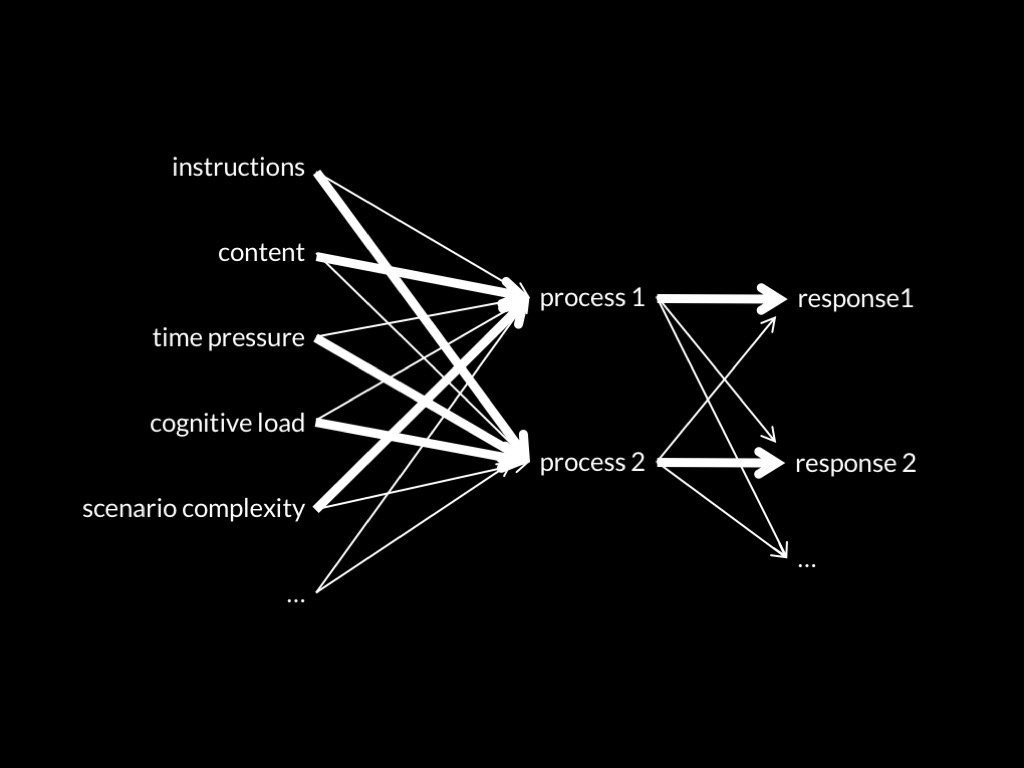
Why is there an apparently conflicting pattern of findings?

insert-transcript#b0f03a68-f8ad-4a69-a42d-48ae815ba76e-here

dual-process theory of

judgement (e.g. risk)

no simple rule about their limits

fast processes use a variety of heuristics

moral cognition

just one simple limit (e.g. distal outcomes)

just one heuristic?

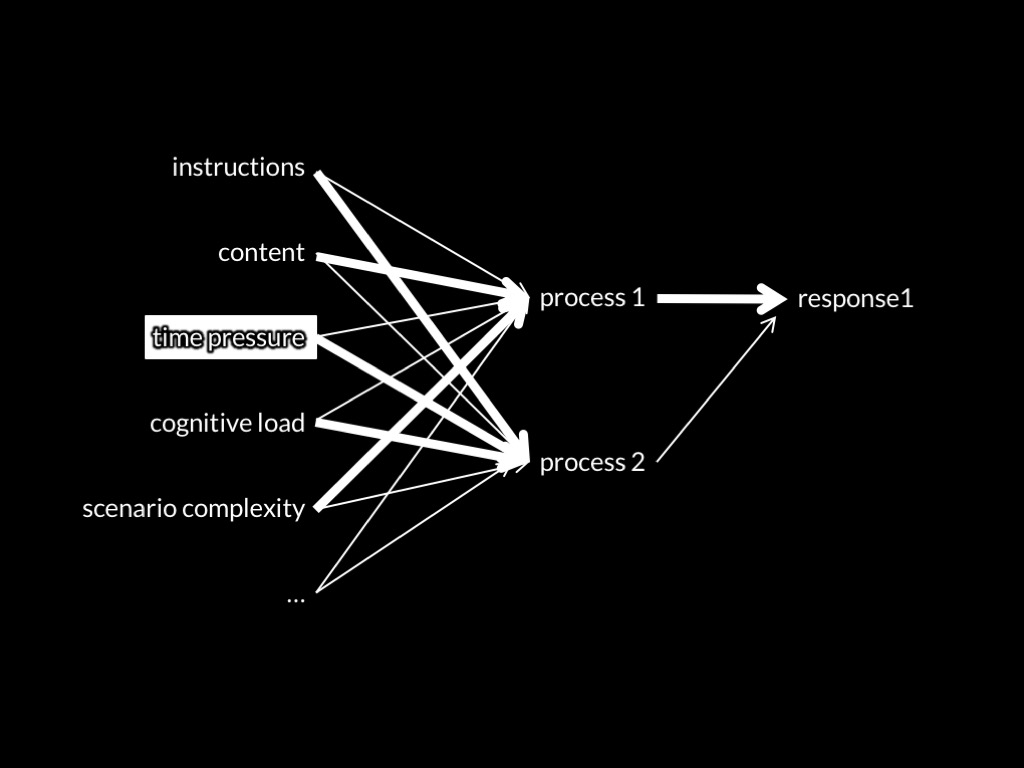
Probably get conflicting results because (i) several heurstics may operate; and (ii) the dilemmas used may vary; and (iii) the timing maybe does not actually generate responses that are much influenced by fast processes since people can decide WHILE READING DILEMMAS.

are these even different theories?

insert-transcript#711a10ef-0139-48fb-a8dd-8e3350b57245-here

more research is needed?

What, if anything, can we conclude despite the mixed evidence?

Why is there an apparently conflicting pattern of findings?

insert-transcript#54afff46-1ebe-4089-b09c-36ef01694eef-here

On balance, it seems reasonable to

(i) deviate from the mainstream in not accepting any auxiliary hypothesis as firmly established while

insert-transcript#d09b2684-5437-4127-9007-3d14e989a4f2-here

Dual Process Theory of Ethical Abilities (core part)

Two (or more) ethical processes are distinct:
the conditions which influence whether they occur,
and which outputs they generate,
do not completely overlap.

One process makes fewer demands on scarce cognitive resources than the other.

(Terminology: fast vs slow)

aux. hypothesis: The slow process is responsible for characteristically consequentialist responses; the fast for other responses.

insert-transcript#654bef3d-af31-4ead-86e6-8d243785f135-here

On balance, it seems reasonable to

(i) deviate from the mainstream in not accepting any auxiliary hypothesis as firmly established while

(ii) provisionally accepting, in line with the mainstream, that the stripped dual-process theory will turn out to be true.

insert-transcript#9db4afc9-75dc-43ad-a468-018dc27ac748-here

more research is needed?

What, if anything, can we conclude despite the mixed evidence?

Why is there an apparently conflicting pattern of findings?

Over to you: potentially great essay opportunities ...