Click here and press the right key for the next slide.
(This may not work on mobile or ipad. You can try using chrome or firefox, but even that may fail. Sorry.)
also ...
Press the left key to go backwards (or swipe right)
Press n to toggle whether notes are shown (or add '?notes' to the url before the #)
Press m or double tap to slide thumbnails (menu)
Press ? at any time to show the keyboard shortcuts
Appendix: Dual Process Theory and Auxiliary Hypotheses
1. Ethical judgements are explained by a dual-process theory, which distinguishes faster from slower processes.
2. Faster processes are unreliable in unfamiliar* situations.
3. Therefore, we should not rely on faster process in unfamiliar* situations.
4. When philosophers rely on not-justified-inferentially premises, they are relying on faster processes.
5. The moral scenarios and principles philosophers consider involve unfamiliar* situations.
6. Therefore, not-justified-inferentially premises about particular moral scenarios, and debatable principles, cannot be used in ethical arguments where the aim is knowledge.
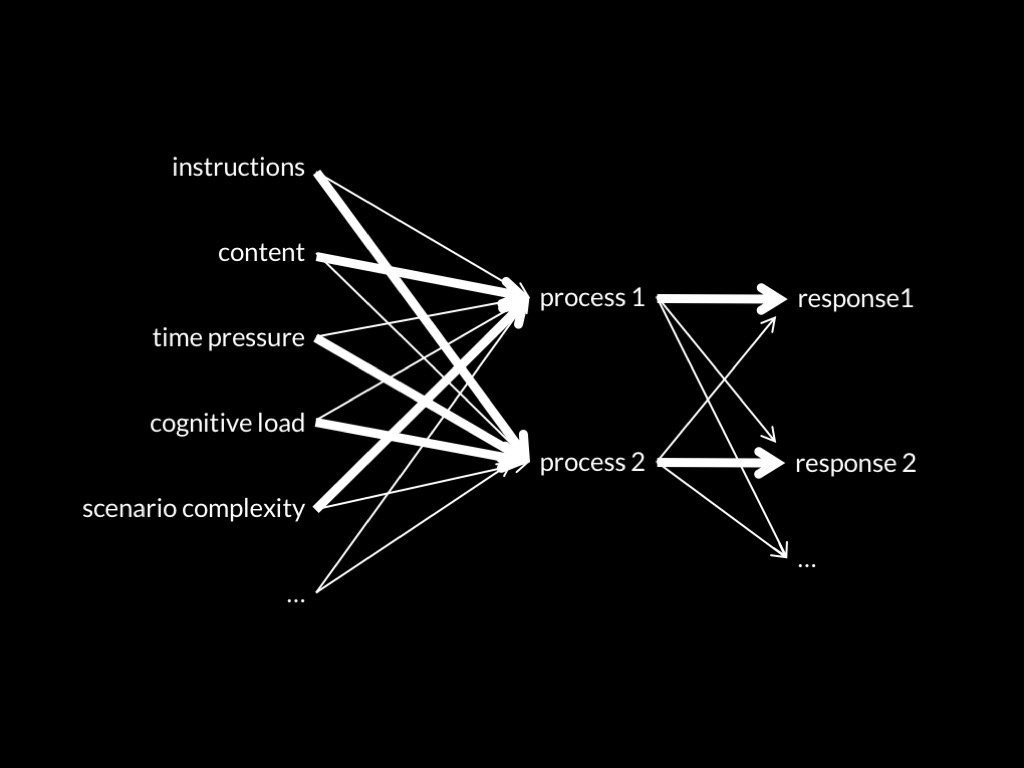
Dual Process Theory of Ethical Abilities (core part)
Two (or more) ethical processes are distinct:
the conditions which influence whether they occur,
and which outputs they generate,
do not completely overlap.
One process makes fewer demands on scarce cognitive resources than the other.
(Terminology: fast vs slow)
Why do we need auxiliary hypotheses?
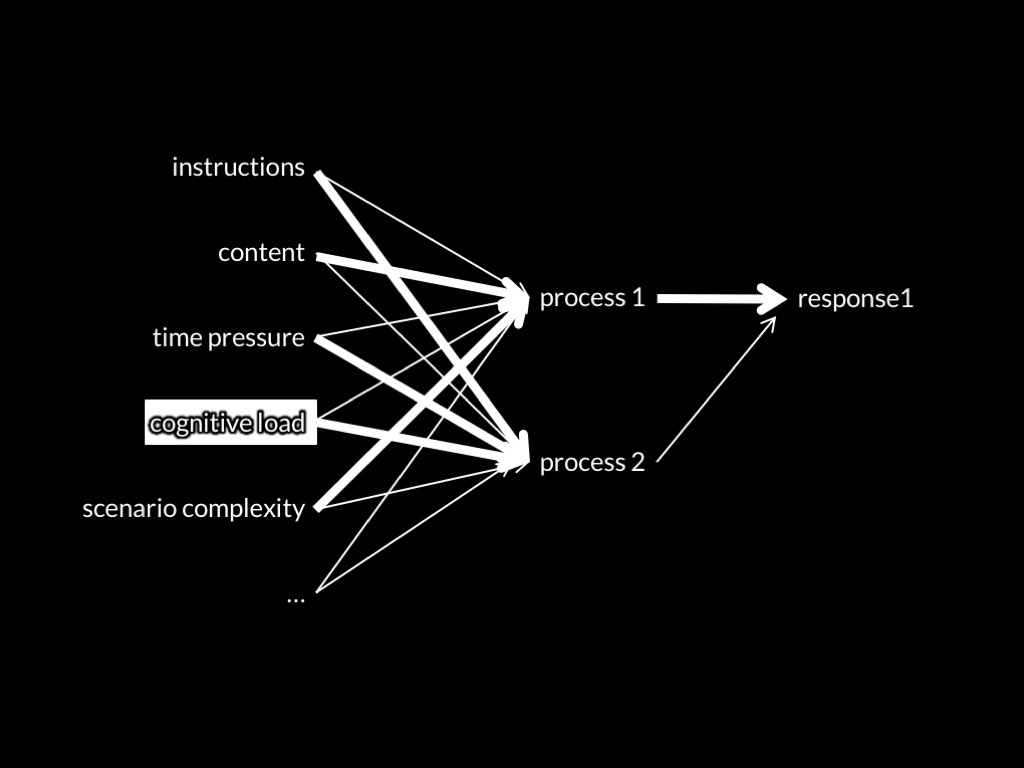
Compare physical cognition:
faster* processes :always characteristically Impetus (errors aside)
slower* processes : sometimes characteristically Newtonian
‘The Central Tension Principle:
Characteristically deontological judgments are preferentially supported by automatic emotional responses processes, while characteristically consequentialist judgments are preferentially supported by conscious reasoning and allied processes of cognitive control’
Greene, 2014 p. 699
‘unless you’re prepared to say “yes” to the footbridge case, your automatic settings are still running the show’
Greene, 2014 p. 723
not consequentialist responses are always a consequence of the fast process
Compare:
faster* processes :always characteristically Impetus (errors aside)
slower* processes : sometimes characteristically Newtonian
candidate auxiliary hypotheses
| fast | slow | source |
| never consequentialist | sometimes consequentialist | Greene (2014) |
| always deontological | sometimes not deontological | Greene (2014) |
| always only act-types | sometimes not only act-types | Cushman (2013) |
| never (distal) outcomes | sometimes (distal) outcomes | Cushman (2013) |
| model-free | model-based | Cushman (2013) |
| affective | cognitive | Greene (2014) |
Dual Process Theory of Ethical Abilities (core part)
Two (or more) ethical processes are distinct:
the conditions which influence whether they occur,
and which outputs they generate,
do not completely overlap.
One process makes fewer demands on scarce cognitive resources than the other.
(Terminology: fast vs slow)
aux. hypothesis: only the slow process flexibly takes into account differences in the outcomes of an action