
Keyboard Shortcuts?f

×
  • Next step
  • Previous step
  • Skip this slide
  • Previous slide
  • mShow slide thumbnails
  • tShow transcript (+SHIFT = all transcript)
  • nShow notes (+SHIFT = all notes)

Please be cautious in using the transcripts.

They were created mechanically and have mostly not been checked or revised.

Here is how they were created:

  1. live lecture recorded;
  2. machine transcription of live recording;
  3. ask LLM to clean up transcript, and link to individual slides.

This is an error-prone process.

Click here and press the right key for the next slide.

(This may not work on mobile or ipad. You can try using chrome or firefox, but even that may fail. Sorry.)

also ...

Press the left key to go backwards (or swipe right)

Press n to toggle whether notes are shown (or add '?notes' to the url before the #)

Press m or double tap to slide thumbnails (menu)

Press ? at any time to show the keyboard shortcuts


Conclusion: Guesses Aren’t Evidence

conclusion

In conclusion, ...
insert-transcript#62e9916d-4166-48e0-84fb-63be11c0f463-here
insert-transcript#e690603b-5999-48a4-9cbe-02816556cec8-here

Not-justified-inferentially premises about particular moral scenarios cannot be used in ethical arguments where the aim is knowledge.

‘One's intuitions are,
I think,
fairly sharp on these matters’
(Thomson, 1976, p. 207).

Return to the aim: provide a different kind of argument.
I think we can avoid both global scepticism AND Rini’s regress challenge by providing an argument based on discoveries in moral psychology.

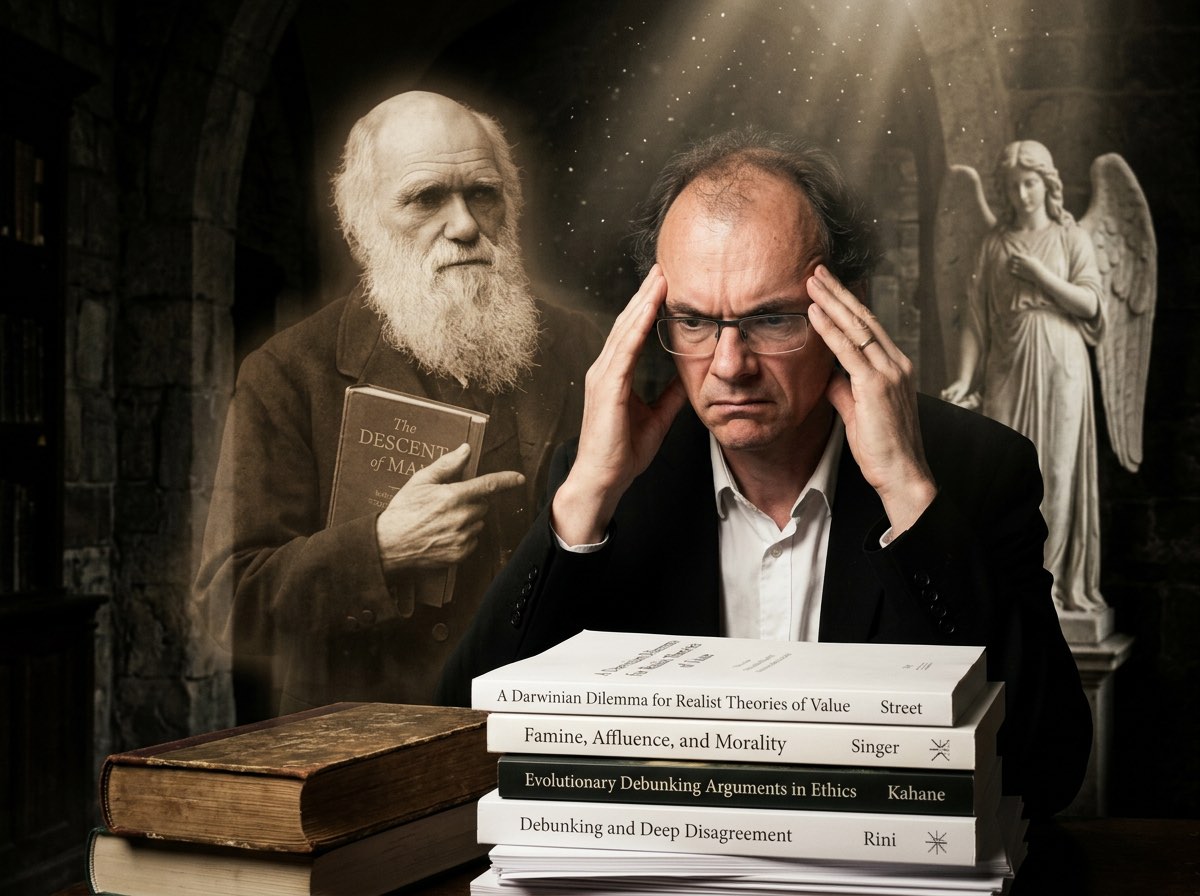
Street: a global evolutionary challenge

Singer/Greene: selective debunking attempts

Rini: selective debunking creates regress.

‘a form of global debunking can evade my regress—precisely because it is not selective debunking.’ (Rini, 2016, p. §5)
insert-transcript#25d0e34d-f6e7-4bf4-ab82-34894868d2d5-here

‘When I have an intuition it seems to me that something is the case, and so I am defeasibly justified in believing that things are as they appear to me to be. That fact [...] opens the door to the possibility of moral knowledge.’

(Kagan, 2023, p. 167)

Reply to this part: there is nothing especially problematic about moral intuitions, as distinct from physical intuitions. We should apply the same standard in both cases.

The sceptic needs to show there is ‘something especially problematic about moral intuitions, as distinct from others.’

(Kagan, 2023, p. 170)

insert-transcript#f1809dab-9cd7-4c77-b65b-75185d7d63d4-here
I will just leave you with the argument we have been studying today.

1. Ethical judgements are explained by a dual-process theory, which distinguishes faster from slower processes.

2. Faster processes are unreliable in unfamiliar* situations.

3. Therefore, we should not rely on faster process in unfamiliar* situations.

4. When philosophers rely on not-justified-inferentially premises, they are relying on faster processes.

5. The moral scenarios and principles philosophers consider involve unfamiliar* situations.

6. Therefore, not-justified-inferentially premises about particular moral scenarios, and debatable principles, cannot be used in ethical arguments where the aim is knowledge.